




Your role in tutoring is not to teach the lesson. It is to be the steady partner around it: a routine at home, a clear conversation with the tutor about goals, a simple way to follow progress, and encouragement that helps your child become more independent. When a tutor and a parent each do their part, the hour of tutoring has far more effect. At Réussite A+, every student follows a customised learning plan with continuous progress monitoring, which gives you something concrete to talk about with the tutor and your child.
TL;DR
- Your main job is to be a partner, not a second teacher: set the routine, share your child’s goals and keep the conversation going.
- Give the tutor the context: your child’s teacher, school, recent results and what worries you most.
- Ask for specifics after sessions (skills covered, strengths, what still needs work) rather than “it went well”.
- Build independence: let your child do the work, and keep your help to questions, encouragement and a calm space.
- If progress stalls, ask for objective data and a revised plan together with the tutor and the teacher.
Table of Contents
- What does a parent actually do in tutoring?
- Why your involvement matters even when the tutor is excellent
- Before the first session: set the goal and share the context
- Building a routine at home
- Communicating with the tutor
- Following progress without turning it into pressure
- Supporting independence: help without taking over
- Online or in person: what changes for parents
- How Réussite A+ works with parents
- Our point of view
- FAQ
- Sources
What does a parent actually do in tutoring?
Parents are often the ones who start the process. A 2024 Alberta study of online math tutoring, based on three high-school students and two parents, found that parents and students were the main decision-makers in seeking and using tutoring. That is a lot of responsibility, and it does not stop once the first session is booked.
In practice, your role has five parts:
- Decide on the goal. Catching up in French grammar, getting comfortable with fractions, preparing for a secondary school entrance exam: the goal shapes the plan.
- Create the conditions. A regular time, a quiet spot, a working device and a charged headset.
- Communicate. Tell the tutor what you see at home and ask what the tutor sees in sessions.
- Follow progress. Look at skills, not only marks.
- Encourage independence. The goal is a child who needs less help over time.
Notice what is not on the list: doing the homework, drilling your child at the dinner table or re-teaching the lesson after the session. A meta-analysis of tutoring experiments for preschool to Grade 12 by Andre Nickow found that effects were stronger for teacher and paraprofessional tutoring than for parent tutoring, and that parent-tutoring programs usually give parents training and materials first. The strongest results come when trained tutors teach and parents back them up. That is the division of work that makes sense for most families.
Why your involvement matters even when the tutor is excellent
Tutoring works. A Toronto Metropolitan University review by Kelly Gallagher-Mackay reports that high-dose tutoring, several times a week, has a consistent and substantial positive impact on achievement. The same review of 12 Canadian studies found that all of them identified positive effects, including parent satisfaction and improved learning, and that two recommendations came up again and again: keep students engaged and tailor the program to each student’s needs.
Both of those depend on information only you have. A tutor sees your child for an hour. You see the tired Tuesday, the sigh over a reading passage, the sudden pride after a good quiz. When you share that, the tutor can adjust the plan. That is why a personalised plan and an involved parent go together: the plan is only as personal as the information behind it.
Before the first session: set the goal and share the context
A good start takes about twenty minutes of preparation. Write down answers to these questions:
- What is the main goal? (For example: raise a French mark, finish homework without tears, prepare for the entrance exam.)
- Where does your child struggle most: understanding, speed, confidence or organisation?
- What did the last report card or exam say?
- What does your child enjoy and what do they avoid?
- How much time can your family realistically commit each week?
The Learning Disabilities Association of PEI recommends that parents set clear tutoring goals, ask for a written plan and involve the child’s teacher so the plan links to school work. A Vancouver School Board guide for families makes a similar point: tell the tutor the child’s teacher and school so an appropriate support plan can be discussed. Although that guide is from British Columbia, the principle holds anywhere: the tutor works best when school and tutoring point in the same direction.
If you are still choosing, our guide to criteria for choosing a good school tutor and the printable list of tutoring consultation questions help you prepare for the first conversation. Our first tutoring session plan explains what that first meeting looks like.
Safety and supervision for online sessions
Online tutoring is convenient: your child can log in right after school from the kitchen table. It also means you are the adult on site. Be nearby for the first sessions, especially with younger children, check that the session happens on a platform you know, and keep the device in a shared space. The Vancouver School Board guide notes that when tutoring takes place at home, it should be at a time when a parent is also at home. The same logic applies online. Our page on three online tutoring safety steps before lesson one walks through the basics.
Building a routine at home
A routine is the simplest and most powerful thing a parent controls. A tips sheet from George Mason University recommends a consistent schedule, a comfortable, quiet and organised study space, and a review of previous work before sessions.
Here is a mini-checklist you can use before every session:
- Same day and time each week, so the session becomes a habit and not a negotiation.
- A snack and a glass of water beforehand.
- Notebook, pencils, the current school work and any questions your child wrote down.
- Device charged, internet tested, headset ready.
- Five minutes of calm. No scolding about last week’s mark just before the session.
That last point matters. Children learn better when they arrive relaxed and ready to ask questions. Treat the session as a good moment of the week, not as a punishment for a bad mark.
A realistic weekly rhythm
For a Grade 5 student in Laval working on French with one session a week, a simple rhythm looks like this:
- Before the session: your child picks one thing they found hard at school and writes it on a sticky note.
- During the session: you stay nearby, but out of the lesson, unless the tutor invites you in.
- Right after: two minutes together. “What did you work on? What was easiest? What was tricky?”
- Later in the week: ten minutes of the practice the tutor suggested, in a playful form, not as extra homework.
The same shape works for a Secondary 2 student in Longueuil who needs help with algebra, or a student in Montreal preparing for an entrance exam. Only the content changes.
Communicating with the tutor
Clear communication is the heart of the parent’s role, and the most common weak point. A Stanford toolkit for families notes that caregivers often find talk about academic progress unclear and recommends concrete ideas of what to talk about and do at home. The fix is to ask specific questions.
Questions worth asking after a session
LD OnLine suggests spending a little time with the child and tutor after each session to ask which skills were the focus, what the child’s strong areas were, what still needs work, and what activities to do at home. Turned into a short script:
- Which skill did we work on today?
- What went well?
- What is still shaky?
- What can we practise this week, and for how long?
- Is there anything from school the tutor should know about?
The same source recommends that you talk regularly with your child’s teachers and share that information with the tutor. A short message such as “the teacher said the dictation on Friday covers past participles” lets the tutor line up the next session with the classroom.
How often, and in what form?
A few habits keep communication light and useful:
- A two-minute check-in after each session, or a short written summary if your schedule is tight.
- A fuller review every month or so, looking at the plan and the goal together.
- A quick note whenever something changes: a new unit at school, an upcoming exam, a stressful week.
The Stanford toolkit also suggests text reminders on tutoring days increase attendance, so a reminder on the fridge or your phone is a small action with real value.
Listening to your child
Your child is also part of the communication. LD OnLine advises parents to listen to and observe their child’s feelings and rapport with the tutor and to talk through any problem. If your child says the pace is too fast, or the examples feel boring, pass it on. A good tutor wants to know, and the plan can change quickly.
Following progress without turning it into pressure
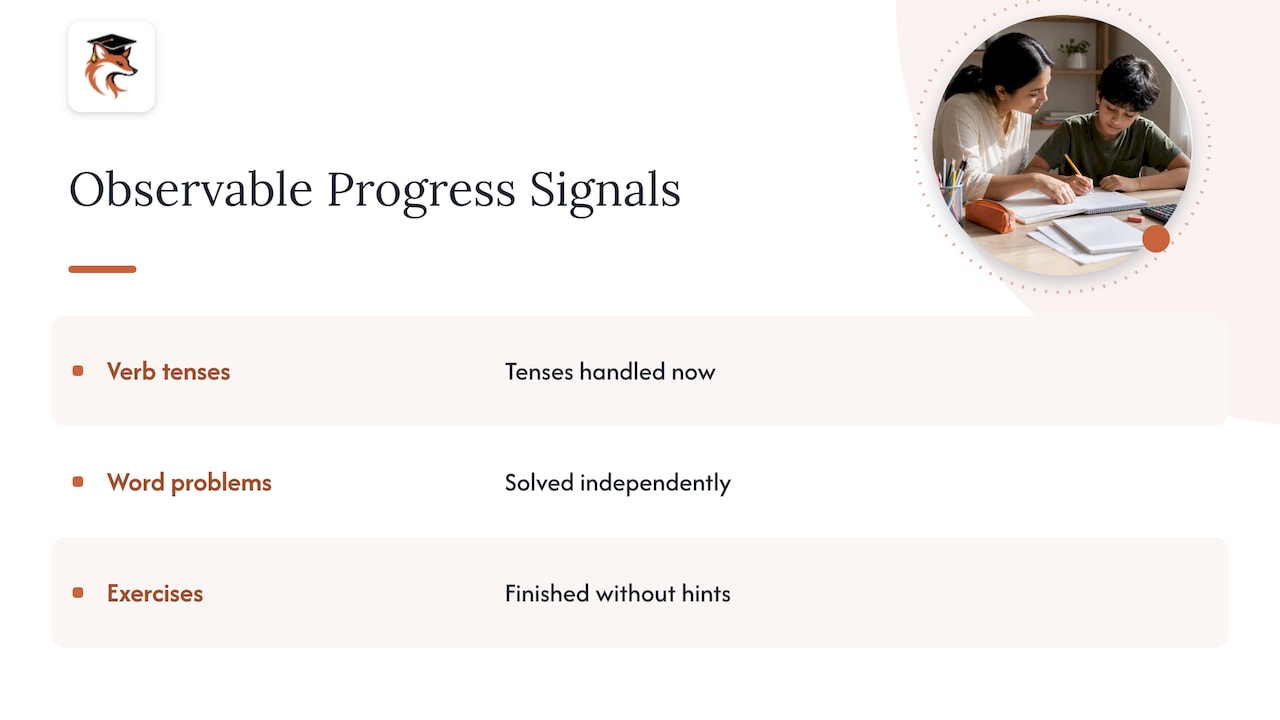
Marks matter, but they come late. Skills move first. Ask for progress in terms you can see: which verb tenses your child now handles, which types of word problems they solve alone, how many exercises they finish without a hint.
Dyslexia Canada advises parents not to accept vague updates and to insist on clear, objective progress-monitoring data showing which skills are mastered and which still need work. It adds that the plan can then be adjusted if the child is not on track for the agreed goal. At Réussite A+, continuous progress monitoring is part of our methodology, so that conversation starts from facts both of you can see.
The LD Association of PEI notes that noticeable academic improvement is typically expected within a few months. Keep that timeline in mind: one tricky week is not a verdict, and a steady trend over a couple of months is more telling than a single mark.
Our article on how online tutoring helps parents monitor academic progress goes deeper into what to track.
When progress stalls
If results are flat after a reasonable period, treat it as information, not failure:
- Ask the tutor for the current skills picture: mastered, in progress, not yet started.
- Compare it with what the teacher is seeing in class.
- Check the basics: frequency of sessions, sleep, workload, confidence.
- Agree on one or two changes to the plan, such as a narrower focus, more frequent short sessions or a different practice format.
- Set a date to review again.
Dyslexia Canada describes this as a “layered support” approach, where the tutor, school and family align their strategies and language so instruction is consistent across settings. It is a good model for any child, not only those with learning difficulties.
Supporting independence: help without taking over
The best sign of good tutoring is a child who needs you less. Several habits help.
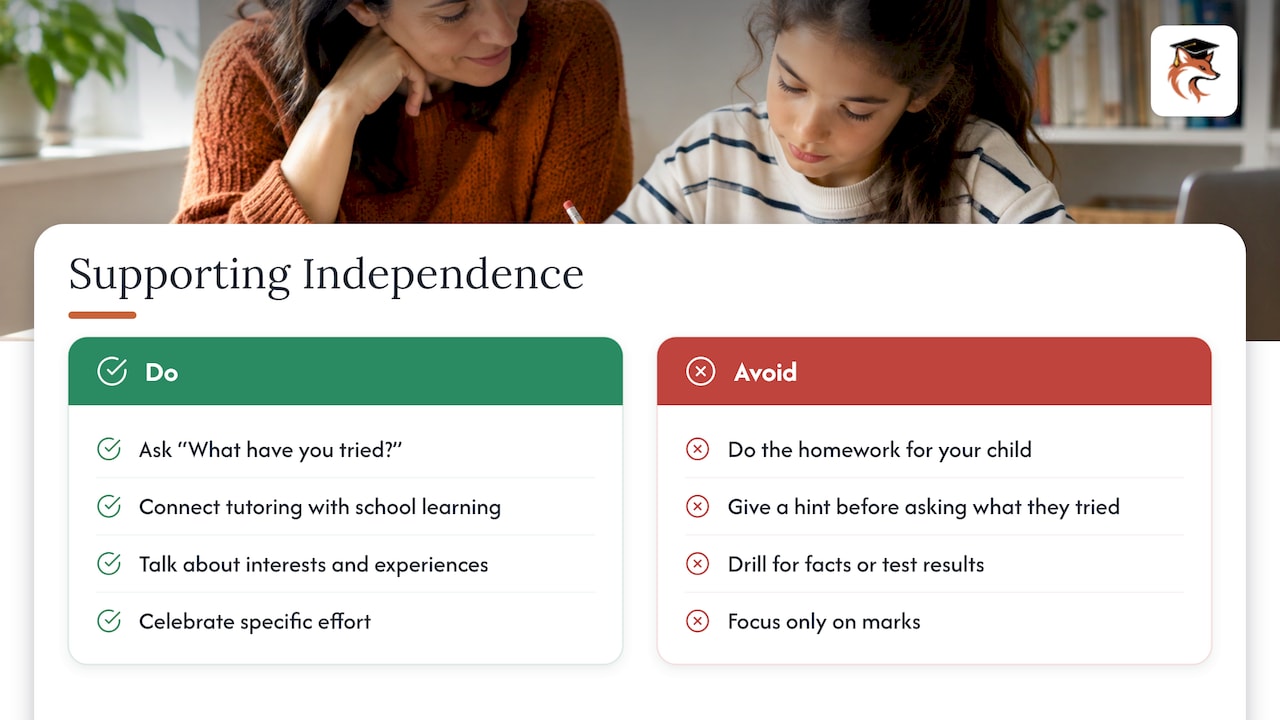
Let your child struggle a little. If your child is stuck, ask “What have you tried?” before offering a hint. The Vancouver School Board guide says a good tutor never does the homework for the child and always works with the child so assignments are understood. Parents can follow the same rule at home.
Link school and tutoring. The George Mason tips sheet says that talking about connections between school learning and tutoring helps the child take ownership of learning, with more attention to asking questions, seeking clarification and using strategies on purpose. A simple question does it: “Where could you use what you learned today in class this week?”
Talk, don’t grill. An Ontario parent-engagement resource, citing researcher Carl Corter, reminds parents that their greatest influence comes from talking with children about interests and experiences, not drilling for facts or grilling for test results. Replace “What mark did you get?” with “What was the most interesting thing you learned?”
Keep it fun. Tutor and consultant Sandy Fleming, quoted by LD OnLine, gives parents enjoyable activities and homework games that reinforce what is being studied. A card game for multiplication or a word hunt in a cereal box counts as practice.
Celebrate effort. Name the specific thing: “You reread your sentence and found the agreement mistake yourself.” That builds the habit of self-checking.
Online or in person: what changes for parents
In both formats your role is the same. In online tutoring, a few things shift in your favour:
- No travel, so sessions fit more easily into a weekday evening.
- You can sit nearby and hear the tone of the session without sitting in the room.
- Material, notes and exercises are easy to share digitally.
What you add is the technical and supervision layer: stable internet, a quiet corner, a device without distractions, and a short check that your child is logged in on time. Our comparison of home tutoring and online tutoring and the guide to how an online tutoring session works cover what to expect.
There is also a bigger picture. The Alberta study describes tutoring and schooling blurring into what it calls “transboundary learning”, which makes it more important that parents connect the two worlds for their child.
How Réussite A+ works with parents
Our online tutoring covers elementary and secondary students across Quebec, with a focus on French and mathematics. Each student receives a customised learning plan built around strengths, challenges, pace and goals, and our tutors are selected from the university level for academic excellence and teaching ability. Programs include regular sessions, summer sessions, homework help and exam preparation for secondary school entrance exams.
Sessions are $30-35 per hour, and registration is a one-off fee of $65, as published on our pricing page. Our satisfaction guarantee includes a refund for the first session if you are not satisfied. We have supported more than 3,500 students with a 99% client satisfaction rate. To get started, see registration for tutoring and academic support, or learn more about our French programs.

If you are in Montreal, Laval, Longueuil or elsewhere in Quebec, sessions take place online, at a weekly time that suits your family.
Our point of view
After more than 25 years in education, we have noticed that the families who get the most from tutoring are not the ones who do the most. They are the ones who do the right things: a regular time, a calm start, a short conversation after the session, and patience.
We design each learning plan around the student, and we keep progress monitoring continuous so that parents never have to guess. That is why we encourage you to ask us what your child worked on, what is strong and what comes next. Our tutors are there to teach, so you can stay what your child needs most: a parent who listens, encourages and believes in them.
Your child’s confidence grows when the adults around them work as one team. A parent, a tutor and a teacher who share the same goal give a child a clear path, and that is what we aim to build with every family.
Réussite A+
FAQ
Should I sit in on my child’s tutoring sessions?
For younger children and the first few sessions, being nearby is wise, especially online. As your child gains confidence, step back and let the tutor and student build their own rhythm. Check in briefly afterwards.
How often should I talk to the tutor?
A short exchange after each session is enough for most families, plus a fuller review every month or so. Contact the tutor sooner if something changes at school, such as a new unit, an exam or a drop in confidence.
Should I help with homework as well?
Help with the routine and ask guiding questions, but let your child do the thinking. Tutors reinforce school learning and build study skills, and a good one will not do the homework for the child. If homework causes tension, tell the tutor so it can be part of the plan.
What if my child does not like the tutor?
Talk with your child first to find out what is bothering them: the pace, the style or shyness. Then share it with the tutor or with us. Rapport matters, and the plan can be adjusted. Our guarantee includes a refund for the first session if you are not satisfied.
How long before I see progress?
The LD Association of PEI expects noticeable improvement within a few months. You may see more confidence and better focus earlier. Ask for a skills summary to see the trend.
Sources
- From the Peripheral to the Transboundary (University of Alberta journal, 2024)
- The Evidence for Tutoring to Accelerate Learning (Toronto Metropolitan University, 2022)
- The Impressive Effects of Tutoring on PreK-12 Learning (ERIC, 2020)
- Hiring a Tutor (Dyslexia Canada)
- Parents Partnering with Tutors (LD OnLine)
- Considering a Tutor (Vancouver School Board)
- Parent Engagement: Working with Families Supporting Student Learning (Ontario)
- High-Impact Tutoring Family and Caregiver Toolkit (Stanford)
- Tips on Selecting a Tutor for Your Child (LDA of PEI)
- Tutoring Tips for Parents (George Mason University)