




Mental math is not about racing the clock. It is about knowing a handful of flexible methods and choosing the one that fits the numbers in front of you. Children who learn those methods, one at a time and with someone checking how they think, calculate more accurately and worry less about maths. At Réussite A+, our tutors build this into each student’s personalised plan, and this guide gives you the same core strategies to try at home.
TL;DR
- Teach a few strategies, not a single trick: making 10s, doubling and halving, compensation, breaking numbers apart and working left to right.
- Speed is not the goal. Canadian curriculum documents stress flexibility, accuracy and explaining your thinking.
- Ten to fifteen minutes, a few times a week, with a game and the question “What strategy did you use?” is enough.
- Use a calculator for exploring patterns and bigger problems, and put it away when the lesson is about mental strategies.
- Mental strategies are the groundwork for algebra, because they rely on the properties of operations.
Table of Contents
- What mental math really is (and what it is not)
- Eight mental math strategies to teach your child
- Number sense activities that fit a busy evening
- How much practice is enough?
- Calculators and mental math: friends, not rivals
- Teaching the order of operations without tears
- Why mental math is the on-ramp to algebra
- Our perspective
- Get a plan built around your child
- FAQ
- Sources
What mental math really is (and what it is not)
Mental math means calculating, estimating or visualising using number relationships a child already knows, without pencil, paper or calculator. That is how the Peel District Catholic School Board’s maths FAQ defines it. It is not the same as memorising facts, and it is not a speed contest.
The Ontario Grade 4 curriculum says it plainly: speed is not the goal. The value of mental math is that it travels with your child and that it deepens their understanding of numbers. A child who can say “I did 6 × 8 as 5 × 8 plus one more 8” understands multiplication. A child who simply recites 48 may not. The OAME’s guide to effective instruction uses that exact example, and warns that students who only practise rote procedures are at a disadvantage when later grades turn more abstract.
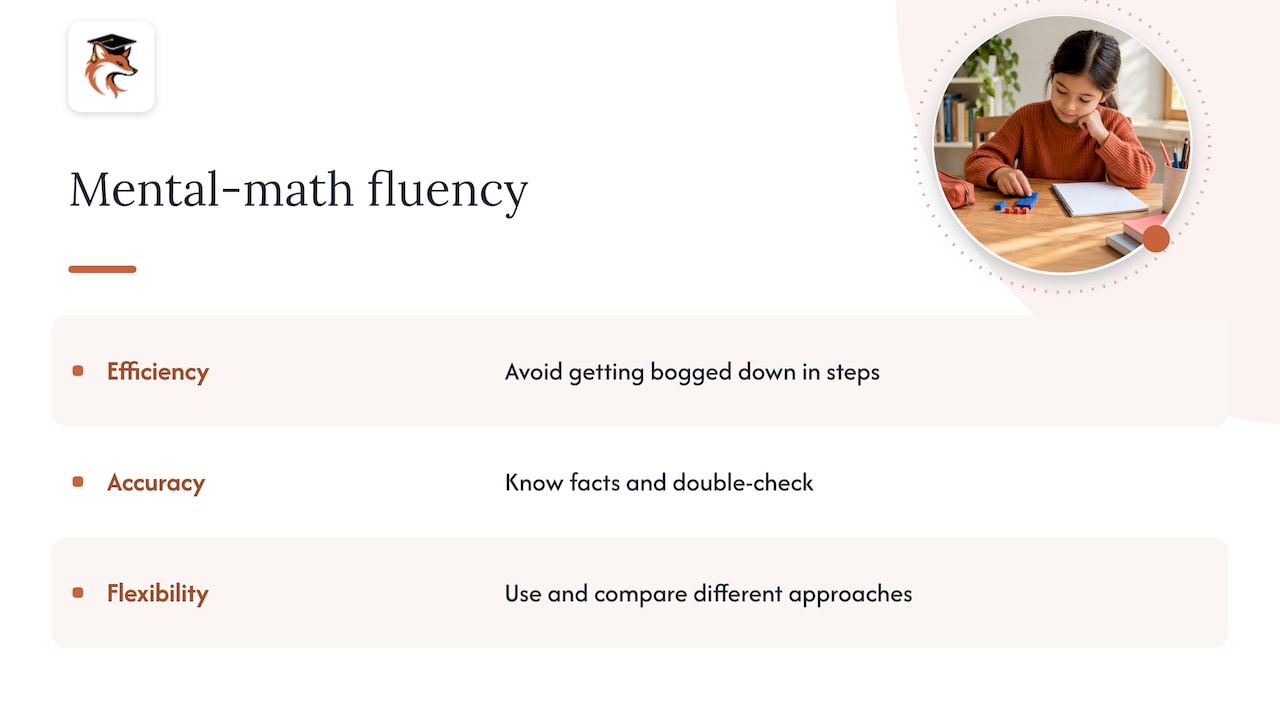
A useful way to think about fluency comes from Lynne McClure at NRICH, who describes three parts: efficiency (not getting bogged down in steps), accuracy (knowing facts and double-checking) and flexibility (knowing more than one approach and using one to check another). Every strategy below builds at least one of these.
Eight mental math strategies to teach your child
Introduce one strategy at a time. Let your child use it for a week of short practice before adding the next. Each one below includes a worked example you can say out loud at the kitchen table.
1. Make 5s and 10s
The Peel FAQ lists making 5s and 10s among the core strategies. For 8 + 6, your child takes 2 from the 6 to turn the 8 into 10, then adds the remaining 4: 14. This is the first strategy most children meet, and it supports almost everything that follows. In Grade 1, Ontario students are expected to use mental strategies to add and subtract within 20 and explain how they did it.
2. Make jumps of ten
For 47 + 30, picture a number line: 47, 57, 67, 77. Jumping by tens is the bridge between counting and place value. Ask your child to say each landing spot out loud. Later, the same habit makes 47 + 28 easy: jump 20, then 8.
3. Break numbers apart (decompose)
For 34 + 25, split into tens and ones: 30 + 20 = 50, 4 + 5 = 9, so 59. The Peel FAQ calls this composing and decomposing numbers. It also works for multiplication: 7 × 14 becomes 7 × 10 plus 7 × 4, which is 70 + 28 = 98. This is the distributive property at work, and the Ontario curriculum shows the same idea with percentages: 70% of 22 is 70% of 20 plus 70% of 2.
4. Add and subtract from the left
Paper methods start on the right, with the ones. In your head, starting on the left is often easier: for 58 + 27, add 50 + 20 = 70, then 8 + 7 = 15, then 70 + 15 = 85. Manitoba Education’s mental math document lists adding from left to right among its core strategies, and notes that standard written algorithms often need more steps when done mentally, which raises the chance of error.
5. Compensation (round, then adjust)
For 49 + 36, think 50 + 36 = 86, then take away the 1 you added: 85. For 198 + 45, think 200 + 45 = 245, then subtract 2: 243. Encourage your child to say “I rounded up by 1, so I take 1 back.” That sentence is the strategy.
6. Double and halve
To find 5 × 18, halve the 18 and ten-fold it: 9 × 10 = 90. For 4 × 15, double 15 twice: 30, then 60. Halving one factor and doubling the other keeps the product the same, which turns many hard multiplications into easy ones. Manitoba’s list names doubling and halving as a standard strategy.
7. Use a known fact
If your child forgets 6 × 8, they can build it from 5 × 8 = 40 and add one more 8. Same for 9 × 7: take 10 × 7 = 70 and subtract 7. This is the best antidote to panic during a test, because a forgotten fact becomes a short puzzle instead of a blank. If your child is still shaky on facts, our guide on how to achieve math facts mastery gives a practical routine.
8. Multiply and divide by 10, 100 and 1000
In Ontario’s Grade 4 expectations, students multiply by 10, 100 and 1000 and divide by 10 mentally, and explain why. The key idea is that digits shift place value, not that you “add zeros”. That wording matters later with decimals: 8 ÷ 10 is 0.8, and “adding a zero” does not explain it. Manitoba’s later-grade list includes annexing zeros and moving the decimal point for the same reason.
As a quick check at home, use this mini-checklist:
- Can my child name the strategy they used?
- Can they explain why it works in one sentence?
- Can they solve the same problem a second way to check?
If the answer to all three is yes, the strategy is theirs.
Number sense activities that fit a busy evening
Strategies stick when practice feels like play. Nova Scotia’s Math Minds at Play home kit offers three games that need almost nothing:
- Number Jump: draw a number line in chalk, roll dice and jump. Challenges include skip counting by 2s.
- Giant Number Line: a 0 to 20 line where your child builds addition and subtraction sentences and shows each jump with their feet.
- Hit the Target: use two to four cards and plus or minus to get as close as possible to a target number. Raise the target to 30, 50, 100 or even 1000, and bring in multiplication and division as your child grows.
The kit advises keeping games fun and at the right level, and pairing them with questions such as “Explain your thinking”, “How do you know?” and “What strategy did you use?”. Those three questions do more for number sense than any worksheet.
For younger children, we have more ideas in our post on quick and fun mental arithmetic methods for 7 to 9 year olds. If your child enjoys fractions in game form, try these fraction games for elementary school. And in December, our Christmas math games make a good holiday routine.
How much practice is enough?
Less than most parents expect. The Toronto District School Board’s research series recommends 10 to 15 minutes a few times a week, focused on approaches rather than speed, with time to discuss the different strategies used.
A simple weekly rhythm:
- Monday: one new strategy, three examples said aloud.
- Wednesday: a game (Hit the Target works for most ages).
- Friday: two or three questions from daily life, such as splitting a restaurant bill or doubling a recipe. Ask your child to solve each one in two different ways.
Keep the mood light. Marian Small, quoted in the Peel FAQ, explains that solving questions mentally pushes students to focus on relationships between numbers rather than just memorising rules. A child who feels pressured goes back to guessing. A child who feels safe starts noticing patterns.
Calculators and mental math: friends, not rivals
Parents often worry that a calculator will undo all the mental work. The research is more reassuring. The Peel FAQ says calculator use should be restricted only when students are focusing on mental-math strategies, and cites research that found calculators improved conceptual knowledge, problem-solving and computation without hurting paper-and-pencil skills. The TDSB report adds that the Ontario curriculum treats the calculator as an important problem-solving tool, while NCTM reminds teachers that calculators do not remove the need for mental and written proficiency.
In practice, this gives you a simple rule: mental strategies first, calculator to explore and to check. One good activity comes straight from the Ontario Grade 4 curriculum: enter 26 × 10 and press equals repeatedly, watching the digits slide one column left each time. Then divide by 10 and watch them move into the decimals. Before using the calculator, your child predicts 8 × 10, 8 × 100, 8 × 1000, 800 ÷ 10 and 8 ÷ 10, then checks. The calculator becomes a way to test ideas, which is exactly what we want.
Teaching the order of operations without tears
Order of operations is the rule about which part of a multi-step calculation you do first: brackets, then exponents, then multiplication and division, then addition and subtraction. In Ontario, it appears as a formal expectation in Grade 7 and extends to rational numbers in Grade 8. Quebec’s own progression differs, so check your child’s school materials for the grade where it is introduced.
Well before it is formal, though, children meet the idea. The Ontario Grade 4 curriculum asks students to solve problems that need more than one operation and to check their calculations. Here is how to make it concrete:
- Start with a story. “You buy 3 packs of 4 stickers and 2 single stickers.” That is 3 × 4 + 2 = 14, not 20. The story shows why multiplication comes first.
- Show the wrong answer on purpose. Calculate 2 + 3 × 4 left to right (20) and then correctly (14). Let your child decide which matches the story.
- Use brackets as a tool. “Two friends each buy a sticker pack of 4 and a single sticker”: 2 × (4 + 1) = 10.
- Make a mini-game. Give three numbers, such as 2, 3 and 4, and ask how many different answers they can make using plus, times and brackets. Each result teaches the rule.
The common trap is the mnemonic recited without meaning. Pair every rule with a story so your child can reason about it.
Why mental math is the on-ramp to algebra
Algebra readiness is mostly number sense with letters added later. The Ontario Ministry of Education’s 2020 curriculum context document states that understanding the properties of operations is essential for developing understanding of both arithmetic and algebra.
See the link in practice. When your child computes 7 × 14 as 7 × 10 + 7 × 4, they are using the distributive property, the same rule that later lets them expand 7(x + 4). When they double and halve, they are using the idea that equivalent expressions keep their value. Children who have only memorised procedures tend to stall here, because there is nothing flexible to build on. The Peel FAQ, drawing on the work of Jo Boaler and Marian Small, recommends a mix of strategy-based problems and motivating fact games over blind memorisation.
If your child is in the early years of secondary school and gaps are showing, our guide for Quebec parents on closing Secondary 2 math gaps in six weeks shows how to prioritise, and our overview of core math topics for entrance exams shows where mental strategies pay off most.
Our perspective
In our 25 years of educational experience, we have learned that mental math is rarely a talent problem. It is a method problem. A child who is stuck on 8 + 6 often has not been shown that a number can be split, moved and put back together.
That is why every student at Réussite A+ receives a customised learning plan built around their strengths, challenges, learning pace and goals. One child needs to rebuild the facts they know. Another already calculates well and needs strategies for larger numbers and an introduction to algebraic thinking. The same list of tricks cannot serve both.
Our tutors are selected from the university level for their academic excellence and teaching ability, and we monitor progress continuously, so each strategy is introduced when your child is ready for it and checked until it holds. We keep the atmosphere encouraging, because a calm child thinks more clearly than an anxious one.
More than 3,500 students have worked with us. What we want most for yours is simple: to say “I know how to figure that out” instead of “I can’t.”
Réussite A+
Get a plan built around your child
If you would like these strategies taught step by step by a university-level tutor, our online maths tutoring for elementary and secondary students across Quebec, including Montreal, Laval and Longueuil, is designed for exactly that. Sessions are scheduled flexibly, use custom educational material and come with progress tracking.
Regular, exam-preparation and homework-help sessions are $30–$35 per hour, with a one-off registration fee of $65 listed on our rates page. If you are not satisfied with the first session, we refund it. You can learn more about our online math course or our regular session, and if your child is struggling right now, start with our action plan for parents.
FAQ
At what age should children start learning mental math strategies?
Early. In Ontario, Grade 1 students are already expected to use mental strategies to add and subtract within 20 and to explain them. Start with making 5s and 10s, number lines and simple games, and add strategies gradually as your child grows more comfortable.
Should my child memorise multiplication tables or learn strategies?
Both, in the right order. Strategies such as using a known fact give your child a way to rebuild a forgotten fact, which in turn makes the facts easier to remember. The OAME guide illustrates this with 6 × 8 built from 5 × 8 plus another 8.
How do I know my child is improving if we are not timing them?
Watch the explanations. A child who can name the strategy, say why it works and solve the same question a second way is progressing, even if they are not fast. Accuracy and flexibility come first, and speed follows naturally.
Can mental math help with exams?
Yes. Quick estimation lets your child spot answers that are too large or too small, and mental fluency frees working memory for multi-step problems. For Quebec families, our primary school exam preparation plan for French and math shows how this fits into regular follow-up.
Sources
- Mental Math: Grade 8 Mathematics, Manitoba Education
- Ontario Grade 4 Mathematics, Strand B2
- The Ontario Curriculum, Grades 1 to 8: Mathematics (2005)
- Ontario Grade 1 math curriculum expectations
- Frequently Asked Questions, Peel District Catholic School Board math resources
- A Guide to Effective Instruction in Mathematics, K to 6, OAME
- Developing Number Fluency, NRICH
- Math Minds at Play, Nova Scotia
- Effective Instructional Strategies, TDSB Research Series
- Ontario Mathematics Curriculum Expectations, Grades 1 to 8 (2020)
- The Ontario curriculum, grades 1 to 8, put into context (2020)