




The most reliable way to quickly improve your child's academic performance is through personalized and structured tutoring, including an initial assessment, measurable goals, and qualified tutors. Quebec Government Tutoring Program This confirms the value of individualized support, and services like Réussite A+, with its large number of students supported and high satisfaction rate, are a concrete example. If your child has been stagnating for several weeks, the next step is simple: request a diagnostic assessment before the end of the month.
In short:
- Personalized tutoring based on precise diagnosis and measurable objectives is more effective than homework help in providing a lasting solution to academic difficulties.
- The quality of service is based on the tutor's experience, knowledge of the Quebec program, regular follow-up and flexibility of arrangements, rather than on the hourly rate.
- Concrete progress often appears after four to six weeks of regular sessions, particularly in addressing targeted gaps or boosting the student's confidence.
- The average cost of support varies between €20 and €70 per hour depending on the tutor's profile and the chosen formula, with options in person, online or in small groups.
- Success also depends on the involvement of families, who must prepare the ground and follow the reports to maximize the effectiveness of tutoring.
Table of contents
- Why personalized tutoring works better than homework help
- How to choose a personalized, paid tutoring service?
- What plan should I follow during the first eight weeks?
- How long does it take to see a real improvement?
- How much does academic support actually cost in Montreal?
- In-person, online, or small group tutoring: which to choose?
- Concrete progress observed among Montreal students
- Success A+, support designed for measurable results
- What we are really observing among families
- Sources
- F.A.Q
Why personalized tutoring works better than homework help
Homework help addresses the evening rush: finishing the exercise, understanding the day's instructions. Tutoring aims for something else. According to the Quebec government's Tutoring Program, it allows for adapting instruction to the varied and changing needs of each student, in an ongoing rather than ad hoc manner. In practical terms, it's not just about correcting the day's exercise; it's about rebuilding the missing foundational knowledge.
The same ministerial framework highlights a second benefit, often underestimated by parents: tutoring strengthens a child's sense of competence and supports their long-term perseverance. A child who finally understands why they were wrong regains confidence, far beyond the grade received.
How can you tell if you're still in the realm of homework help or if it's time to invest in paid tutoring? Several signs are unmistakable:
- Grades have been falling for more than six to eight weeks despite homework being done seriously.
- Your child can no longer work alone without constant supervision.
- A crucial exam is approaching (end of year, preparation for entry into secondary school).
- Homework becomes a source of daily conflict at home.
Pro tip: Don't confuse a single bad exam with a persistent difficulty. Structured tutoring is justified when the problem recurs over several weeks, not after a single disappointing grade.
How to choose a personalized, paid tutoring service?
The hourly rate isn't the right starting point. Tutoring guides in Montreal recommend comparing teaching methods, follow-up, and flexibility before even considering the price. Here are six criteria that truly make a difference:
- The proposed teaching method Does the tutor adapt their method to your child's profile, or do they apply a fixed program?
- The tutor's experience and training : prioritize a university level and several years of real-world experience with primary or secondary school students.
- Knowledge of the Quebec program : a tutor who is proficient in the Ministry's curriculum saves valuable time on alignment with school assessments.
- Monitoring and reporting : ask if you will receive regular statements, not just an invoice.
- The flexibility of the terms online, in person or hybrid, depending on the family's pace.
- Price transparency : a clear package, with no hidden fees announced afterwards.
Before signing, also check the contractual clauses. In Quebec, a tutoring service contract legally binds a obligation of means rather than an obligation of result The service provider commits to implementing a rigorous method, not to guaranteeing a specific rating. Ensure that the cancellation policy, payment terms, and privacy protection, as governed by Law 25, are clearly stated in writing.
During the initial consultation, ask specific questions: What frequency of sessions do you recommend for this profile? What tools do you use to track progress? How will I know in two months if it's working? Vague answers are a red flag.
What plan should I follow during the first eight weeks?
Serious coaching never begins with an impromptu session. It follows a progression that you can demand from the very first contact.
- Week 1, the initial diagnosis. The tutor assesses your child's actual progress in French or mathematics, identifies specific gaps in knowledge, and provides a short report. Allow for one dedicated session, without any mixed homework assignments.
- Weeks 2 to 3, defining measurable objectives. Rather than "improving in math," aim for "mastering fractions" or "structuring an argumentative paragraph." The recommended pace is between 60 and 90 minutes once a week for in-depth monitoring, with a higher frequency in case of exam preparation or rapid catch-up.
- Week 8, the summary. Compare the results to the objectives set in week 2 using short tests or graded assignments. Three possible outcomes: continue at the same pace, intensify the work before an exam, or adjust the method if progress remains insufficient.
This roadmap provides a verifiable framework, rather than a subscription whose success is uncertain.
How long does it take to see a real improvement?
The first signs of progress often appear after four to six weeks of regular sessions, provided the recommended pace of one to two sessions per week is maintained. This timeframe corresponds to the time needed to address a specific gap, such as a poorly understood mathematical concept, and for the student to apply the method independently, without direct supervision.

For broader consolidation, such as restoring confidence to a child who has been struggling for several months, allow a full term. The difference lies in the nature of the problem: an isolated technical deficiency can be resolved quickly, while a general loss of study skills requires more consistency.
Preparing for a secondary school entrance exam follows a different schedule, more constrained by the exam date. In this case, intensifying your preparation with two sessions per week, several months before the exam, yields better results than starting late at the last minute. This is why the four- or eight-week assessment mentioned above is designed to detect early on whether the chosen pace is sufficient, rather than discovering it the day before the exam.
How much does academic support actually cost in Montreal?
Local guides point to indicative price ranges Tutoring rates range from approximately $20 to $35 per hour for a student tutor, up to $40 to $70 per hour for a qualified teacher or experienced university tutor. This is just a starting point; the actual cost also depends on the chosen frequency and duration of the tutoring.
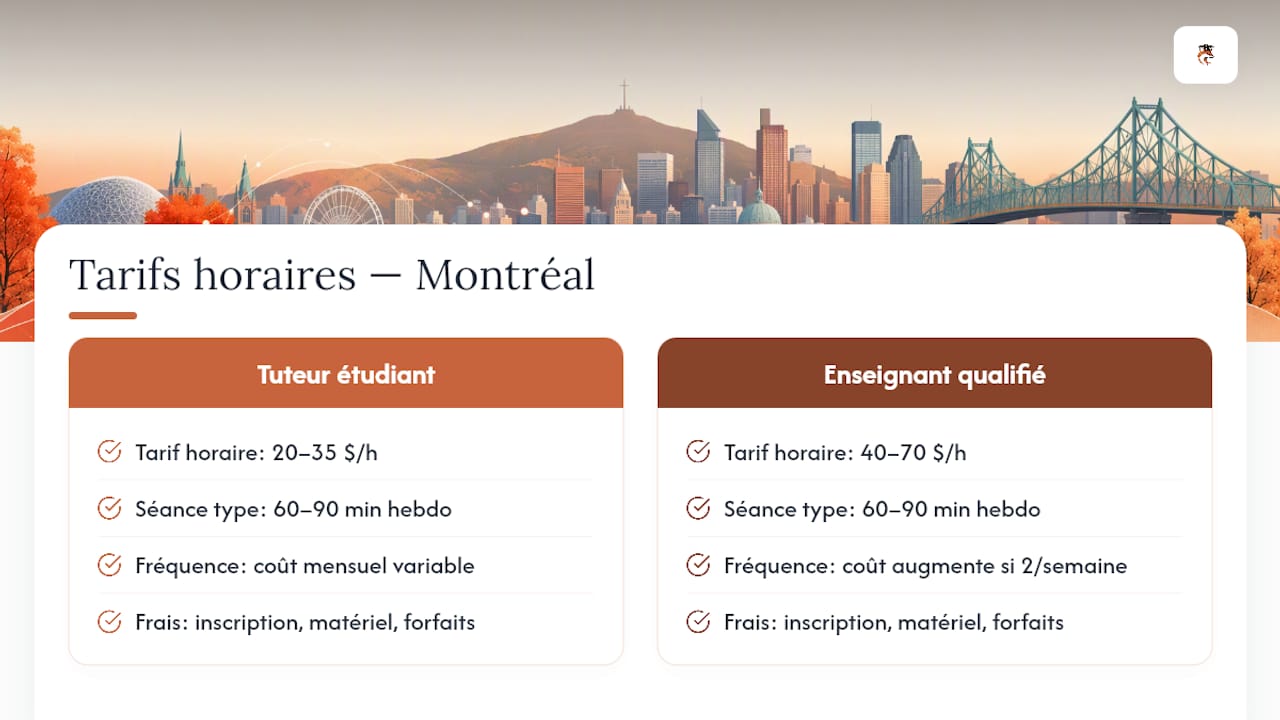
For a weekly session of 60 to 90 minutes over several weeks, the monthly budget varies depending on the hourly rate chosen. During periods of increased intensity, with two sessions per week before an exam, the cost logically increases.
Other fees are sometimes added to the base price: one-off registration fees for certain intensive sessions, supplementary teaching materials, or prepaid packages that reduce the unit cost but require a commitment to several sessions. well-drafted service contract must specify these elements in advance, along with the payment terms (per session or bi-weekly billing) and a clear cancellation policy.
In-person, online, or small group tutoring: which to choose?
Each format meets a different need, and the right choice depends primarily on your child's profile rather than a general preference.
Le individual online tutoring It is best suited to children who progress through close monitoring and constant adjustment of pace. It eliminates travel, which facilitates regular sessions, a factor often more crucial to results than the format itself.
Le individual in-person tutoring retains an advantage for younger primary school students, who sometimes need a physical presence to stay focused, or for children with special needs requiring very close support.
Le small group (Two to four students) reduces the cost per participant and works well for reviewing a common concept before an exam, but it dilutes the attention given to each student. It's a supplementary format, rarely sufficient on its own to fill a persistent gap in knowledge.
The hybridThis approach, combining online sessions during the week with occasional in-person meetings, is increasingly appealing to Montreal families seeking a balance between flexible scheduling and regular human contact. However, the individual online format remains the one that offers the best balance between personalized support and accessibility, particularly for families spread across Montreal, Laval, and Longueuil.
Concrete progress observed among Montreal students
The most revealing cases often involve upper elementary school students struggling with fractions or the structure of an argumentative text. After a targeted initial assessment, followed by six to eight weeks of weekly sessions focused on the specific gaps identified, these students generally regain sufficient autonomy to tackle a similar exercise on their own, an objective that the Quebec Tutoring Program places precisely at the heart of its definition of tutoring.
For students aiming for entry into a specific secondary school program, the approach differs slightly: the intensification begins earlier, several months before the exam, with two weekly sessions rather than one. Families who start late, a month before the exam, achieve more limited progress due to a lack of time to solidify the foundations.
One point consistently emerges in parents' feedback: a child's perseverance improves as much as their grades. A student who understands why they were struggling with a particular type of problem then approaches assessments with less anxiety, which has a ripple effect on other subjects, even without dedicated tutoring.
Success A+, support designed for measurable results
A+ Success is the preferred option for structured support in Montreal, Laval, Gatineau or Longueuil: unlike occasional homework help, each course starts with a diagnosis and is built around verifiable objectives rather than billed hours without a clear direction.

The team relies on university-level tutors with over 25 years of combined experience in French and mathematics tutoring. The methods remain flexible, ranging from individual online sessions to targeted exam preparation. secondary school entrance exams or intensive courses during the summer, without obligation to commit to a long-term subscription.
If your child shows any of the signs mentioned above, the Complete checklist for academic support helps you structure your decision before contacting a service provider. For families also considering a language immersion program in addition to academic tutoring, a Young Learners stay in Canada can strengthen English practice outside of school. The next step remains simple: book a diagnostic assessment on Reussiteaplus to accurately determine your child's level before the start of the assessments.
What we are really observing among families
One case comes up frequently: a sixth-grade student, struggling with fractions for months, regains his confidence after six weeks of targeted sessions and a clear diagnosis of the root cause of the problem. The parents who achieve the best results are not those who put in the most hours, but those who remain involved without taking on the role of tutor: they prepare the ground, read the reports, and let the method do its work.
What many families underestimate is the time it takes to see a real change in a child's independence, not just in their grades. Often, the children who are most anxious about exercises are the ones who progress the fastest, once they understand that making mistakes is part of learning.
— Jad
Sources
- Tutoring Program | Government of Quebec
- Quebec Civil Code (excerpts)
- Find a tutor or homework help in Quebec
F.A.Q
What is the difference between tutoring and homework help?
Homework help addresses the urgent needs of the evening, while tutoring aims for individualized and continuous support that adjusts teaching to the evolving needs of the student, according to the Quebec Tutoring Program.
How long before you see progress with a tutor?
The first signs usually appear after four to six weeks of regular sessions, with a wider consolidation requiring a full three months.
Does the service provider guarantee an improvement in ratings?
No, a tutoring contract in Quebec is based on an obligation of means and not of result: the provider commits to the quality of the method, not to a specific grade.
Does Réussite A+ offer a diagnosis before starting the sessions?
Yes, the support begins with an initial assessment of the child's achievements, followed by measurable objectives and university tutors specializing in French and mathematics.