




Is your child struggling with French or math, homework ending in tears, and you're at your wit's end trying to help without burning yourself out? Tutoring is the answer. In Quebec, it's recognized as regular, personalized support that starts with the student's actual level, addresses gaps before they widen, and reignites their love of learning. At Réussite A+, our university-level tutors provide online support to elementary and high school students across Quebec, with a free trial to get started.
In a nutshell
- Tutoring adapts support to the student's needs and aims to prevent gaps from widening, according to the Government of Quebec.
- Beyond grades, it strengthens the child's confidence, commitment, and perseverance.
- Regularity is paramount: the Ministry of Education considers a minimum of three sessions per week to be optimal, depending on the student's profile.
- At Réussite A+, sessions are paid by the hour ($30 to $35), with no subscription, a free trial, and a money-back guarantee for the first session if you are not satisfied.
Table of contents
- What tutoring really brings to your child
- Signs that your child might benefit from it
- Tutoring or homework help: what's the difference?
- What role does the tutor play?
- How often and for how long?
- Online tutoring: practical and effective when done well
- How much does tutoring cost at Réussite A+?
- Why summer is a good time
- Preparing for secondary school entrance exams
- Start with A+ Success
- Our point of view
- F.A.Q
- Sources
What tutoring really brings to your child
The Quebec Ministry of Education defines tutoring as regular and personalized support, individually or in small groups, intended for students experiencing certain academic difficulties, according to its frameworkThe important word is TailoredIn a classroom setting, the teacher has to keep up with twenty-five students. In tutoring, all the time is devoted to your child: to what they understand, what interests them, and their own pace.
The Quebec government summarizes the benefits as follows: support is tailored to the student's needs, helps them mobilize their knowledge, and supports their new learning. It also aims to support their well-being, engagement, and perseverance, according to the page of the Tutoring program.
Specifically, you can expect the following from tutoring:
- A better understanding. The tutor picks up the concept where the student left off, instead of letting the student memorize without understanding.
- More confidence. Repeated small successes give children a sense of accomplishment. In fact, the Quebec framework makes this a goal: to strengthen a child's sense of self-efficacy.
- Greater autonomy. A child who understands the instructions and knows where to start needs less of us sitting next to him every night.
- Quieter evenings. When another person takes charge of the explanation, the house becomes a place where people talk about something other than homework.
What the research says
A review by Canadian researchers (Gallagher-Mackay et al., 2022) concludes that intensive tutoring, offered several times a week, consistently and substantially improves achievement, particularly among students with significant difficulties. You can read it in The Evidence for Tutoring.
A meta-analysis of 96 randomized trials, reported by the University of Toronto Mississauga, also showed that students tutored in mathematics or English outperformed their peers in more than 80% of the studies. results of this search Furthermore, they indicate that trained tutors, whether teachers or paraprofessionals, achieve better results than volunteers. Therefore, choosing a tutor is just as important as deciding to begin.
Signs that your child might benefit from it
You don't have to wait for a failing grade. Quebec guidelines recommend referring students to tutoring as soon as academic difficulties are identified and occasional help is no longer sufficient, based on their profile, strengths, and challenges, according to the summary sheet from the ministry.
This might be something you consider when you observe, for example:
- French or math homework that takes hours or ends in conflict;
- errors that recur from one dictation or exam to another (agreements, problem-solving, reading instructions);
- a child who says "I'm useless" or who avoids the subject;
- a score that drops even though the effort remains the same;
- an entrance exam for secondary school or admission to a particular program is approaching.
The Quebec program also targets the first signs of disengagement: absences, lateness, lack of involvement. If your child no longer wants to go to school, it's a signal to take seriously, just as much as a bad grade.
For a primary school child, starting early is a real advantage. A solid foundation in reading, grammar, and arithmetic simplifies all of secondary school. For a student preparing for the entrance exam to a private school or a program like the MYP, tutoring helps structure revision and practice under exam conditions.
Tutoring or homework help: what's the difference?
The two are similar, but their effect is different. Homework help helps the student understand and complete their evening assignments. It's invaluable: your child finishes their homework knowing they've truly understood it.
Tutoring goes further. The CTREQThe Quebec Centre for Educational Success describes it as personalized and regular support, specifying that with a trained tutor in contact with the family or school, it is not limited to homework. It also addresses strategies, fundamental gaps in knowledge, study methods, and confidence.
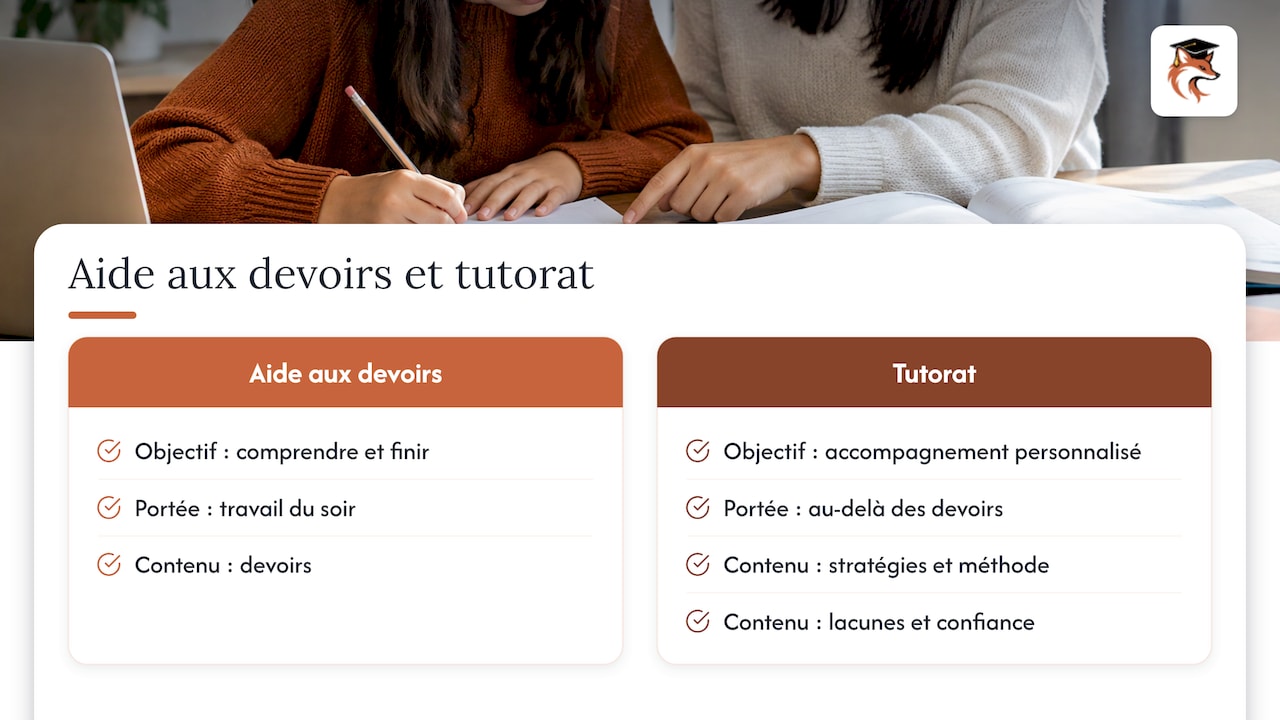
At Réussite A+, both exist: homework help and tutoring in French and mathematics are done with the same tutors, and you can adjust the content of the sessions to your child's progress.
What role does the tutor play?
According to the ministry's framework, the tutor first establishes a relationship of trust with the student, identifies their needs and strengths, and then adapts their support accordingly. They also take into account any potential obstacles, whether cognitive, social, psychological, or emotional, and maintain communication with the school.
This is exactly what you want from a tutor: someone who doesn't just redo the exercise for the child, but teaches them to read the instructions, spot tricky words, and check their answer.
Why the quality of the tutor makes all the difference
The Gallagher-Mackay synthesis highlights that tutor training and supervision, frequency, duration, setting, and a structured program all influence outcomes. Our tutors are university-qualified. We draw on over 25 years of experience and regular progress monitoring to ensure each session builds upon your child's existing knowledge.
How often and for how long?
There is no universal duration, and the ministry makes this clear: it all depends on the student's profile. Here are the official guidelines and those from the research community:
| Benchmark | What the sources say |
|---|---|
| Frequency | A minimum of three sessions per week is considered optimal by the Ministry of Education, depending on the student's profile. |
| Session duration | Sessions last from 20 to 90 minutes depending on age; for younger children, shorter sessions of 20 to 30 minutes are preferred. |
| Duration of service | 20 weeks or less under the Quebec program |
| Research (CTREQ) | At least three times a week for several weeks, sessions generally lasting 45 to 60 minutes, adjusted to age |
The key takeaway: the regularity The key is to take time. One hour a week can be helpful for an exam, but a child who is falling behind progresses better with more frequent sessions. A 7-year-old can't sit still for 90 minutes in front of a screen, and that's not the point.
For a realistic plan, start with the situation:
- A boost before an exam : a few sessions focused on the concepts to be reviewed.
- A gap to make up : regular sessions over several weeks, with a specific objective (for example, fractions or past participle agreement).
- A child from whom we want to prevent the deviation : continuous and light monitoring, adjusted to each stage of the year.
Online tutoring: practical and effective when done well
Online tutoring eliminates the need to travel between school, work, and activities. It's well-suited to families in Montreal, Laval, Longueuil, or Gatineau, as well as those in regions where local options are limited. The child works from home, in a familiar environment, and the tutor remains the same from week to week.
For the sessions to be successful, a few simple steps can help:
- choose a quiet place, with a good connection;
- have the notebook, instructions and previous exam at hand;
- note down before the session the two or three points that are causing problems;
- keep the sessions at fixed times, so that the child can prepare for them.
Regularity is key: that's why we schedule meetings according to the family's timetable, without mandatory subscription.
How much does tutoring cost at Réussite A+?
Our sessions are billed by the hour. Here's what we publish, according to our services pages:
| Service | Price |
|---|---|
| Tutoring and homework help | $30 to $35 per hour |
| Regular session | $30 to $35 per hour |
| Preparation for school exams | $30 to $35 per hour |
| Summer Session | $30 to $35 per hour |
| Exam preparation session | $30 an hour |
| Registration fees | $65, one-time payment |
| Free try | $ 0 |
You can pay per session, with a prepaid package, or be billed every two weeks. There's no subscription to sign. If you're not satisfied with your first session, we'll refund it: that's our satisfaction guarantee.
The final price depends on the student's level and the service chosen. See each service's page for the current price list.
Why summer is a good time
Summer isn't just a break: it's the ideal time to consolidate what's been learned in the past year, without the pressure of homework and exams. A child who returns in September with fresh knowledge starts the year with confidence. Our summer sessions These are aimed at students who want to catch up or get ahead in French and mathematics.
Preparing for secondary school entrance exams
The entrance exam for a private school or a program like the MYP requires thorough preparation: question types, time management, and careful reading of instructions. Tutoring allows you to simulate the exam, correct mistakes, and calm nerves—a crucial factor for success that shouldn't be underestimated. Our exam preparation session is charged at $30 per hour, in addition to a one-time registration fee of $65.
Start with A+ Success
We provide online tutoring for elementary and high school students in Quebec, offering homework help, exam preparation, and intensive summer courses in French and mathematics. We have already helped over 2500 students, and our customer satisfaction rate is 99%.
You can start with a free trial, see how your child reacts, and then decide, with no subscription required. Discover our tutoring and homework help sessions ou Register your child for a regular session.

Our point of view
When a parent calls us, they're often exhausted. They've tried explaining division at the kitchen table, helping with spelling, and they feel their child is losing confidence. Our first response: this isn't a failure of the family. It's a time when an outside perspective can help.
After more than 25 years of supporting elementary and high school students in Quebec, we believe in three things. First, a carefully selected university-level tutor can explain things differently if the child didn't understand them the first time. Second, the approach must be tailored to the individual: we start with the child, not a standard curriculum. Finally, monitoring progress is important because parents need to see what's happening.
That's also why we offer a free trial and a satisfaction guarantee: we want your child to feel comfortable from the very first meeting. Our goal is for them to regain their confidence, and for their grades to improve.
Marie
F.A.Q
At what age can tutoring begin?
There is no fixed minimum age; the focus is primarily on the child's need. For younger children, the ministry recommends frequent sessions of 20 to 30 minutes. In elementary school, early intervention helps build a solid foundation in reading and math.
Is tutoring only for struggling students?
It is designed primarily to support students experiencing difficulties, but it also serves children who want to prepare for an entrance exam, consolidate their learning over the summer, or regain confidence. Each session is tailored to the student's level, strengths, and challenges.
How many sessions per week are needed?
The Ministry of Education considers at least three sessions per week optimal, while specifying that the frequency depends on the student's profile. For an elementary school child, short, regular sessions often work better than long, spaced-out meetings.
How much does tutoring cost at Réussite A+?
Our sessions are priced at $30 to $35 per hour, with a one-time registration fee of $65. There are no subscriptions, and the first trial is free. Detailed pricing for each service is available on our pricing pages.
Which subject should I choose first: French or mathematics?
Start with the one that causes the most stress at home. These are the two subjects where we support the most students, and increased confidence in one often carries over to the other.
Sources
- Tutoring Program | Government of Quebec
- Tutoring program, Reference framework
- Tutoring Program, Summary Sheet
- How to improve the effectiveness of tutoring? | CTREQ
- The Evidence for Tutoring to Accelerate Learning
- New research shows tutoring can improve academic outcomes | Université de Toronto Mississauga