


If you are looking for la The first year of primary school is not to be missed; there are actually two key moments: the 1st and 2nd year (the first cycle), where the foundations in reading, writing and mathematics are laid, and the 6th yearwhich prepares students for the transition to secondary school. The middle years are also important because they bridge the gap between the two. Here's why, what the Quebec program includes, and how to identify a child who needs extra support early on.
In a nutshell
- Quebec primary school lasts six years and is divided into three two-year cycles: 1st-2nd, 3rd-4th and 5th-6th year.
- The first cycle is described by the ministry as the time when the most crucial learning for the future begins: reading, writing and arithmetic.
- The 6th year is the pivotal year: ministerial exams, final report card, sometimes entrance exams for private schools or special programs.
- No year is "unimportant": a delay detected early can be more easily made up for. Parents and teachers are often in the best position to notice this.
- If your child is struggling with French or mathematics, individual support, even short-term, can help restore their confidence.
Table of contents
- How is primary education organized in Quebec?
- The first cycle (1st and 2nd year): where everything is built
- The second cycle (3rd and 4th year): the consolidation period
- Year 6: the pivotal year before secondary school
- What does the curriculum say about what your child needs to learn?
- How can you tell if your child needs support?
- Our perspective on the key years
- Tailored support at every stage
- A simple, year-by-year plan
- FAQ
- Sources
How is primary education organized in Quebec?
Before discussing importance, a simple point of reference. In Quebec, Primary education spans six years.School attendance becomes compulsory at the beginning of the school year for children aged 6 and up. educational system organizes these six years into three cycles of two years each.
| Cycle | years | Approximate age |
|---|---|---|
| Premier cycle | 1st and 2nd year | 6 to 8 year-olds |
| Second cycle | 3th and 4th grade | 8 to 10 year-olds |
| Third cycle | 5th and 6th grade | 10 to 12 year-olds |
Why two-year cycles? The Quebec school training program This framework explains that it takes into account long-term educational interventions necessary for skills development. In other words, a child is not expected to master everything by the end of each year; progress is made over two years. This gives you some flexibility and also a reason not to wait too long before asking questions.
Note: this division is specific to Quebec. Statistics Canada Remember that in most jurisdictions, elementary and secondary school comprise 12 years (grades 1 through 12), while Quebec has 6 years of elementary school and 5 years of secondary school. If you are coming from another province or country, do not compare year by year: the transition point varies.
The first cycle (1st and 2nd year): where everything is built
If you had to choose just one moment, it would be this one. The Ministry of Education presents the first cycle as particularly important, because students begin the most crucial learning for the rest of their schooling during this time: reading, writing and mathematics.
Why is this so important? Because almost everything else depends on it:
- Read more then allows one to understand a math problem, a science instruction, or a social studies text.
- To write requires mastering the sound, the word, then the sentence, before tackling the chords.
- Count it is based on an understanding of numbers and operations, not just on memorizing tables.
The learning progress data at the end of Grade 2 supports this finding. It describes learning that is generally well mastered, but it also reveals areas that pose more challenges for some students, particularly spelling in writing and certain elements related to the meaning of mathematical operations. These are good indicators of what is worth monitoring at home.
What you can do from the 1st year
You don't need to be a teacher. A few simple habits are enough:
- Read every dayEven 10 minutes, aloud or taking turns. On this subject, this text on reading aloud to toddlers reminds us why the pleasure of words begins very early.
- Playing with numbers : counting steps, sharing snacks, comparing quantities.
- To tell Your child's day: putting words to their ideas prepares them for writing.
- Praise the effort rather than the result. A 6 or 7 year old child who feels capable dares to try.
If, despite this, reading remains difficult or the figures remain unclear at the end of the second year, it is not a failure. It is a signal to act early, while the discrepancy is still small.
The second cycle (3rd and 4th year): the consolidation period
It's discussed less, yet it's often where the difficulties arise. In the third year, texts become longer, instructions more complex, and mathematics expands: division, fractions, and problem-solving take up more space. The Ministry publishes a progression of learning in mathematics which specifies the knowledge to be acquired for each year of primary school: it is a good tool to see where your child stands.
A child who has completed the first cycle with some gaps in their knowledge may very well "keep up" in third grade, then fall behind in fourth grade when the concepts pile up. Our experience is that these two years are the best time to consolidate learning: there's still time before sixth grade, and the fundamental concepts that need reviewing are still relatively few.
Year 6: the pivotal year before secondary school
The 6th year is the other big moment, but for a different reason. It's no longer just about building: it's about concluding and preparing for what comes next.
The transition to secondary school
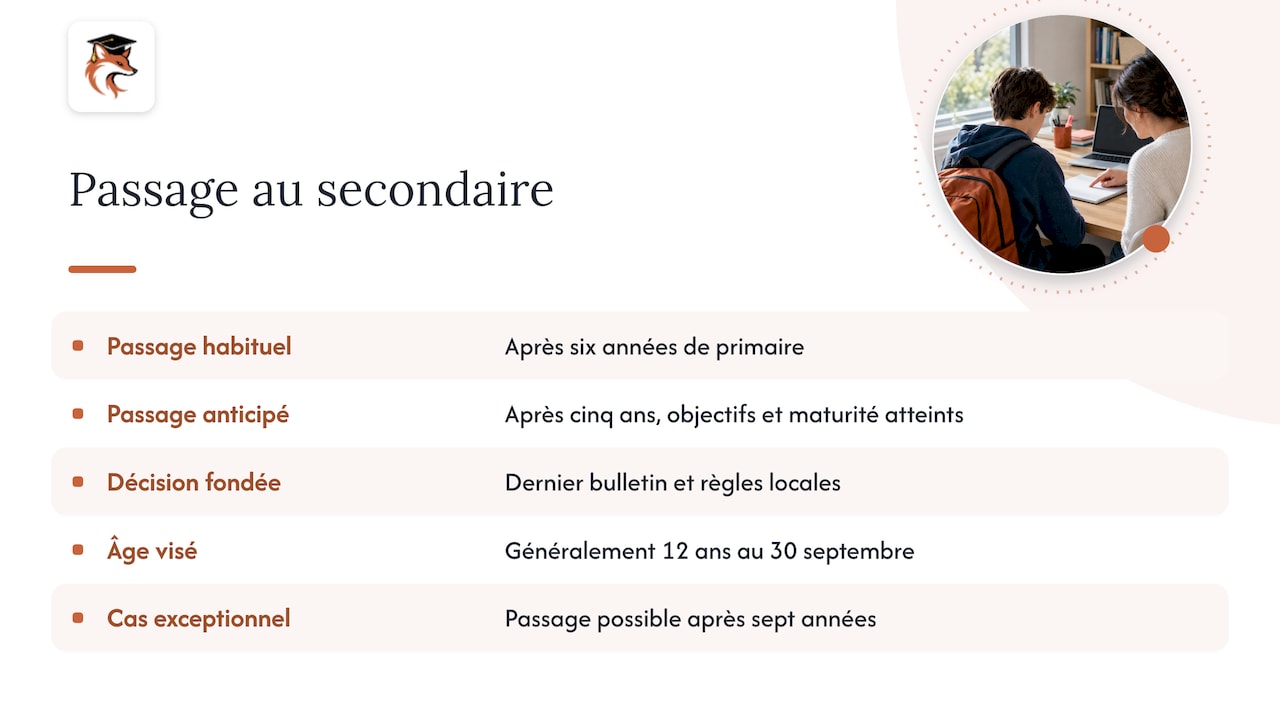
According to educational systemThe transition from primary to secondary school takes place after six years of primary education. It can occur after five years if the student has achieved the primary school objectives and acquired sufficient emotional and social maturity. The decision to move from one cycle to the next is based on the last report card of each year of the cycle and on the rules of passage established by the school or by the school service centre.
Some grading rules even specify the target age: for example, a document intended for parents It mentions that entry into secondary school is generally at age 12 by September 30th after six years, with an exceptional possibility of skipping it after seven years. Check with your child's school to find out the rules that apply in your area.
The ministerial exams for 6th grade
At the end of Grade 6, your child will take provincial exams in French and mathematics. For French, the guide for parents specifies that the test assesses three skills from the program, by means of reading tests (literary text and everyday text) and writing tests.
In mathematics, the information document It indicates that the test assesses the skills "Solving a mathematical problem situation" and "Reasoning using mathematical concepts and processes." It also specifies that, for the 2025-2026 school year, the weighting of the elementary school ministerial tests was 20% of the assessed skill(s). Check with your school each year for the current weighting, as it may change.
The entrance exams
If you're aiming for a private high school or a specific program (like the MYP), Grade 6 also includes entrance exams. These exams, often taken in the fall, primarily focus on French and math. This means that preparation sometimes begins as early as Grade 5, or at the start of Grade 6. There's no need to panic: regular preparation, in small sessions, is better than last-minute cramming.
The transition itself
Changing schools, having a single homeroom teacher for several teachers, changing schedules: the transition to secondary school is also an emotional milestone. The Ministry provides... guides to support the transition from primary to secondary schoolThese guidelines describe what constitutes a successful school transition. Talk to your child about it as early as spring: visit the school, ask questions, and address any concerns. A reassured child learns better.
What does the curriculum say about what your child needs to learn?
Le Quebec school training program defines the expected learning outcomes from grades 1 to 6, grouped into five learning areas. It is supplemented by a tool that indicates the knowledge (essential skills) to acquire and use each yearThese documents help teachers with planning, but you can also consult them to know what to expect.
In practice, for a parent, remember three key principles:
- French : reading, writing and communicating orally, with increasingly demanding spelling and grammar.
- Mathematics : from the sense of number to the resolution of problem situations.
- Other materials They are based on the first two. A child who understands what he reads performs better in science and social studies.
How can you tell if your child needs support?
You know your child better than anyone. One parenting guide It is worth noting that parents and teachers are often best placed to notice unusual behaviors, communication patterns, or learning abilities. It also describes the intervention plan, a tool that relies on parental collaboration to identify a child's abilities and needs.
Here are some questions to ask yourself:
- Is your child avoiding reading or math homework?
- Does he say "I'm useless" or "I'll never understand"?
- Do the same spelling mistakes reappear from one notebook to another?
- Does homework take much longer than before, with tears or tension?
- Does the report show a decline in a specific subject?
One or two "yes" answers don't necessarily indicate a crisis. Talk to the teacher first: they see your child in class and can pinpoint the problem. If you suspect a more specific difficulty (attention, language, reading), the school administration and the professional services department at the school board are the right people to talk to.
Our perspective on the key years
At Réussite A+, we support elementary and secondary school students in Quebec, and we see it every week: the best year to help a child is the one where the first difficulty is noticed.
The first cycle lays the foundation, and we believe it deserves the full attention of parents. But Grade 6 is often when families contact us, because the deadline is real: entrance exams, tests, high school. Our approach is personalized: our university-level tutors adapt to each child's pace and needs, in both French and mathematics.
Our message to parents: you're not behind. A few targeted sessions, a gentle routine, and plenty of encouragement often make a real difference. We've been here for over 25 years to support you.
Marie
Tailored support at every stage
Depending on your child's age, your needs will vary, and so will our services. We offer online tutoring, homework help, preparation for secondary school entrance exams, and intensive summer courses, with university-level tutors and regular progress monitoring.

Sessions are charged at $30 to $35 per hour, with no subscription required and a one-time registration fee of $65. You can start with a free trial, and if you're not satisfied, we'll refund your first session. Discover our tutoring and homework help, our preparation for school exams or our summer session to consolidate what has been learned before the start of the new school year.
A simple, year-by-year plan
Here's a mini-plan to stay on course, without overloading:
| Moment | Priority | Concrete action |
|---|---|---|
| 1st and 2nd year | Reading, writing, number sense | 10 minutes of reading per day, number games, spelling recognition |
| 3th and 4th grade | Consolidate and understand the instructions | Review the instructions together, and revisit any unclear concepts before they become too difficult to grasp. |
| 5th year | Prepare the terrain | Review the basics in French and mathematics, and choose the target schools. |
| 6th year | Tests, admission, transition | Regular practice sessions, discussion about secondary school |
| Summer | Catch up and consolidate | Short routine or intensive session, depending on the needs |
A methodological tip, which we often repeat to students: always read the instructions twice, underline the action verb and spot the trick wordsThis habit, established early, helps as much in reading as in mathematics.
FAQ
What is the most important year in primary school?
The first cycle (grades 1 and 2) is presented by the Ministry as the time when the most crucial learning begins: reading, writing, and mathematics. Grade 6 is also a major milestone, due to the exams and the transition to secondary school. Both deserve your attention.
Can my child go on to secondary school after five years of primary school?
Yes, but only in one specific case: the student must have met the primary school learning objectives and acquired sufficient emotional and social maturity, according to the educational program. The decision rests with the school and is based on report cards and promotion rules. Speak to the administration.
When should you seek help?
As soon as you notice a recurring difficulty, without waiting for the report card, talk to the teacher and then assess whether individual support might help. The smaller the gap, the easier it is to close.
How much does tutoring cost at Réussite A+?
Sessions cost $30 to $35 per hour, with no subscription required, and a one-time registration fee of $65. A free trial is offered, and the first session is refunded if you are not satisfied.
Sources
- Education system, Government of Quebec
- Educational system, Legis Québec
- Decision to proceed, Official Publisher of Quebec
- Presentation of the Quebec Elementary School Training Program
- Quebec Elementary School Training Program
- About the Quebec Education Program
- Progression of learning in mathematics, primary school
- Monitoring of learning in reading, writing and mathematics, 2nd year
- Mathematics, 6th grade, information document
- French, language of instruction, 6th grade, parent's guide
- Rules of passage, parents' document
- Guides to support the primary-secondary transition
- Parents' Guide
- Structure of education and training in Canada, Statistique Canada