




To prepare your child for Collège Letendre, begin with the three admission steps (online application, 4th and 5th grade report cards, and transfer authorization), then solidify their French and math skills well before the exam. This guide explains the steps, the fees published by the college, and the concepts to review. It also shows you how to organize a calm, stress-free study session.
If your child is in 6th grade and Laval is one of your options, you're probably asking yourself the same questions as many parents: what does the process look like, what should I review, and when should I ask for help? Breathe: with a simple plan, it all happens step by step.
In a nutshell
- Admission is done online: form, final report cards from 4th and 5th year in PDF and authorization to transfer file, with a non-refundable application fee of $50.
- An entrance exam is planned, except for students who have at least 90% in French and mathematics in their final report cards for grades 4 and 5.
- The basics to solidify: reading comprehension, grammatical spelling, understanding of the four operations, fractions and problem solving.
- The college offers free academic support and advises students to use a tutor if that is not enough.
- At Réussite A+, the trial is free and our university tutors work online starting at $30 per hour.
Table of contents
- The steps to admission to Letendre College
- The costs to be expected
- What should I review in French before secondary school?
- What should I review in mathematics?
- An eight-week preparation plan
- Managing exam stress
- Learning to get organized before starting middle school
- The support offered at school, and when to consider a tutor
- Our point of view: prepare without putting pressure on
- How A+ Success Can Help You
- When should I start preparing?
- F.A.Q
- Sources
The steps to admission to Letendre College
Letendre College is a private institution located in Laval. admission procedure For secondary education, this involves three main approaches:
- Fill out the online form. A non-refundable $50 application processing fee is associated with it.
- Provide the final report cards for grades 4 and 5 of elementary school, a PDF format.
- Transmit the authorization to transfer information regarding the student.
In addition to this, there is the entrance exam. The college plans a possible exemption for students who obtained at least 90% in French and mathematics on their final report cards for grades 4 and 5, according to the college admissions page.
A practical tip: don't leave the ballots until the end
The admissions page reminds you that report cards must be submitted as soon as possible to complete your application. Therefore, make it a habit to scan report cards as soon as you receive them, name them clearly (for example, "final-report-4th-year.pdf"), and keep them in the same folder. This will help you avoid last-minute scrambles.
Where to check the updated calendar
Admission periods and exam dates change from year to year. Therefore, we do not reproduce them here: please consult the [website/platform name] directly. Letendre College Admissions page to find out the school year calendar that concerns your child.
The costs to be expected
Budgeting is part of the preparation. According to the college's admissions page (admissions 2027-2028), the published amounts are as follows:
| Post | Amount |
|---|---|
| Case review (non-refundable) | $ 50 |
| Tuition fees | $4 965 |
| Registration fees | $ 200 |
| Parents' Association membership fee (per family) | $ 25 |
| Mandatory additional costs | $1 515 |
These figures come from the Admissions and tuition fees page and can be revised: always validate them on the school website. Also note that, according to the College FAQsTransactions and purchases are made through the Coba platform and not directly through its website.
What should I review in French before secondary school?
The school does not publish the detailed content of its exam on the pages we consulted. Therefore, the safest approach is to reinforce what all primary school students should have mastered. The Ministry of Education publishes documents on learning progression which specify, year by year, the knowledge that students must acquire in primary school, particularly in mathematics.
In French, here are the points that we most often see weakening a student at the end of primary school.
Reading comprehension
Even a good reader can lose points if they skim the orderTrain your child to:
- encircle the action verb ("relieves", "justifies", "explains");
- identify the trick words ("except", "only", "at least");
- Return to the text to find the evidence before answering.
A simple trick: after each reading, ask him to summarize the text in two sentences. If he can do it, he has understood the main points.
Grammatical spelling
The agreements keep coming back. Three reflexes are worth their weight in gold:
- Find the verb, then its subject ("who is it that?").
- Make the determiner, noun and adjective agree within the noun phrase.
- Reread, looking for only one error at a time: first the verb agreements, then those of the noun phrase.
Writing
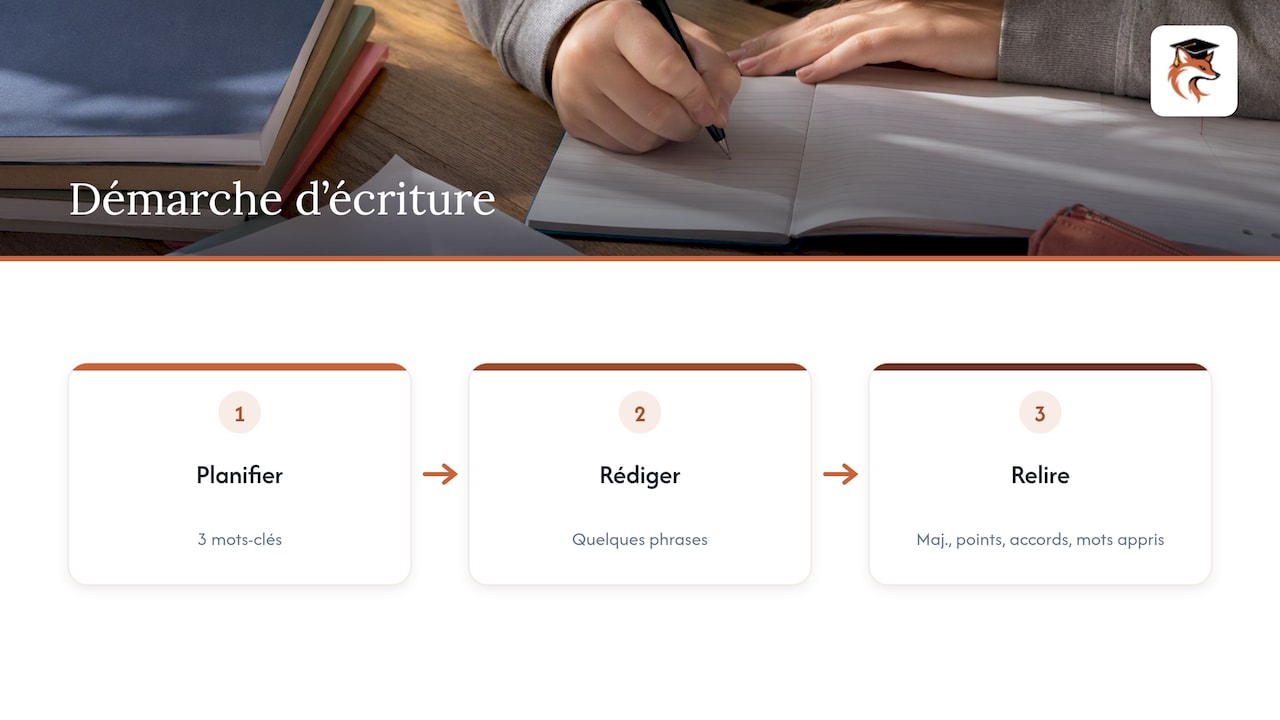
A short, well-punctuated piece of writing, consisting of a few sentences, is better than a long, rambling draft. Suggest that your child plan their work using three keywords before writing, and then proofread it using a checklist: capital letters, periods, subject-verb agreement, and learned vocabulary.
What should I review in mathematics?
In mathematics, difficulties rarely stem from a single chapter. They accumulate when a foundation is weak. Check these points with your child:
- The four operations with natural numbers, including multi-digit division, without a calculator.
- Fractions : compare, simplify, add fractions with the same denominator, convert a fraction to a decimal number.
- Decimal numbers and percentages : reading, comparison, simple calculations.
- Solving written problems : identify the relevant data, choose the operation, check if the answer is plausible.
- Geometry and Measurement : perimeter, area, angles, units of measurement.
The four-step method for a written problem
- Read the problem twice.
- Highlight the question and box the relevant data.
- Write down the operation or draw a small diagram.
- Check: Is the answer logical, with the correct unit?
This routine greatly reduces careless mistakes, which often cost more points than real shortcomings.
An eight-week preparation plan
Here's a mini-plan you can adapt. It requires about 20 to 30 minutes a day, which is still light for an 11-year-old.
| weeks | French | Mathematics |
|---|---|---|
| 1 to 2 | Diagnosis: a dictation and a text to understand | Diagnosis: a few exercises by theme to identify the gaps |
| 3 to 4 | Agreements within the noun and verb phrase | Fractions and decimal numbers |
| 5 to 6 | Comprehension: instructions, trick words, justification | Word problems and percentages |
| 7 | Writing a short text and self-correction | Geometry and measurement, review of errors |
| 8 | Timed mock exam | Timed mock exam |
At the end of each week, take ten minutes to review: what's going better? What's still holding you back? Highlight the progress out loud. Confidence is built with small victories.
Managing exam stress
Stress is part of the process, and it can be managed. Here are a few simple steps:
- Get a good night's sleep the night before and eat breakfast before the exam.
- Remember that the exam checks what he knows, not what he is worth.
- Teach him to skip a difficult question and come back to it.
- Leave two minutes at the end to proofread.
On a daily basis, tell him what he's doing well before talking about what he needs to correct. Children improve faster when they feel capable.
Learning to get organized before starting middle school
Success in secondary school also depends on organization. Collège Letendre describes in its information brochure for parents A portal that brings together the schedule, assignments, report cards, communications with teachers, and notes in the student's logbook. Regular consultation of this portal is considered essential to monitor the student's progress.
In other words, the student and their parents will need to get into the habit of using a digital tool every day. Starting in 6th grade, you can lay the groundwork:
- Use a planner (paper or digital) to note down assignments and exams.
- Do a block of homework at a fixed time, in the same place.
- Go through your school bag on Sunday evening.
- Let your child plan their own reading and revision, with your support.
The support offered at school, and when to consider a tutor
Letendre College offers support measures. According to its page Support measuresStudents can benefit from free academic support sessions with teachers once every nine days, during the lunch hour. In French, the Success Centre offers in-class interventions, small-group reading and writing strategy workshops, and individual meetings to create a self-correction tool. In mathematics, remedial interventions and small-group workshops are available; in the second cycle, math clinics are held during lunch.
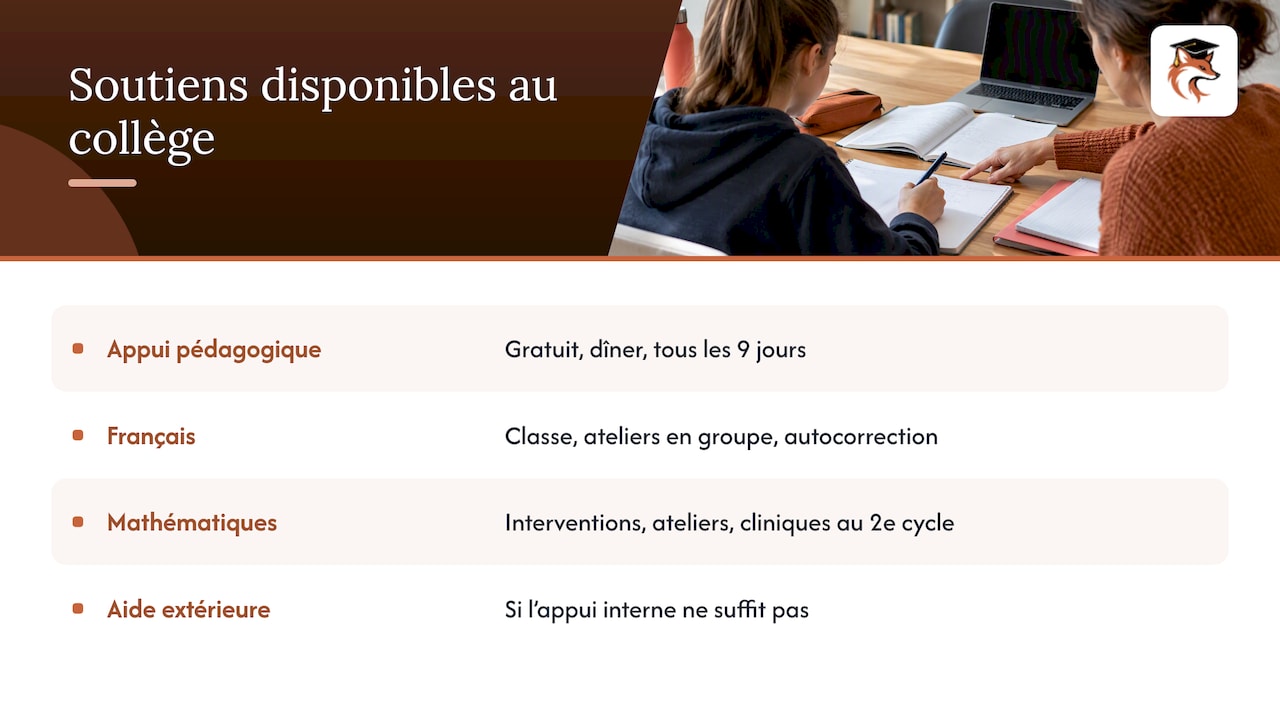
The school also indicates that if this internal support is insufficient, parents can seek external help, such as a tutor or a learning specialist. This is a sound approach: the school does its part, and you supplement it as needed, before the gap widens.
Signs that a helping hand would help
- Your child gets discouraged easily when faced with math or French homework.
- His results are declining from one stage to the next.
- He understands in class, but fails the assessment.
- Homework ends in tears or arguments.
- You are aiming for exemption from the exam (90% or more) and you are missing a few points.
Our point of view: prepare without putting pressure on
For over 25 years, we have been supporting elementary and high school students in Quebec, and we have helped more than 2,500 students. What we observe: the children who perform best on entrance exams are not those who have put in the most hours, but those who have understood Why They are mistaken.
Our approach is based on three ideas. First, a diagnosis: we pinpoint exactly what's causing the problem, whether it's a misread instruction, a forgotten agreement, or a misunderstood fraction. Second, a customized plan with short, targeted sessions, rather than a generic lesson. Finally, regular follow-up, so you can see the progress and your child can feel it too.
Our tutors are university-qualified and can explain the same concept in three different ways until it "clicks." We always keep in mind that a relaxed child learns better. Our goal isn't to cram information into their head, but to give them tools and confidence.
— Marie
How A+ Success Can Help You
If you would like targeted support in French and mathematics, our tutoring sessions are offered online, at a time that suits your family, in Laval and elsewhere in Quebec. You can consult our [website/platform name]. preparation for school exams and our exam preparation session.

Here's what you need to know before you get started:
- Free try to see if there's a good connection between your child and the tutor.
- Published prices $30 per hour for the exam preparation session, and $30 to $35 per hour for tutoring and homework help, both the regular session and the summer session.
- Registration fees of $65 (one time only).
- No subscription : you pay per session, by prepaid package or by bi-weekly billing.
- Satisfaction Guarantee : if you are not satisfied, we will refund the first session.
For more regular monitoring throughout the year, our regular session is made for you, and our summer session This allows you to consolidate the basics before the start of the school year. You can also write to us from the A+ Success homepage.
When should I start preparing?
Sooner is always better, but there's no rush. Ideally:
- From the 5th year : monitor the report cards, since those from 4th and 5th year are used for admission.
- At the beginning of 6th grade : conduct a diagnosis and target the shortcomings.
- A few weeks before the exam : move on to timed mock exams and targeted revisions.
- The summer before the start of the school year : consolidate your learning to get off to a good start in secondary school.
If your child is already in 6th grade and the exam is approaching, don't panic: a few weeks of well-targeted work can make a real difference, especially on careless mistakes and reading strategies.
F.A.Q
What is the admission fee for Collège Letendre?
The application fee is $50 and is non-refundable, according to the college's admissions page. Additional fees for the academic year include tuition of $4,965, a registration fee of $200, a $25 family fee, and mandatory ancillary fees of $1,515. Always check the college website for the most up-to-date amounts.
Does my child absolutely have to take the entrance exam?
Not necessarily. The school offers a possible exemption for students who achieve at least 90% in French and mathematics on their final report cards in grades 4 and 5. Confirm the current requirements on the Admissions page, as they are subject to change.
How to work well in middle school?
Focus on organization: use a planner, a homework block with set times, and regularly check the school portal. Also encourage your child to ask for help early, for example, during teacher support sessions. A tutor can supplement this support if difficulties persist.
Is a tutor helpful before the entrance exam?
Yes, if it addresses your child's specific weaknesses in French and math and helps them manage their stress. At Réussite A+, you can start with a free trial to assess compatibility before committing.
Sources
- Admissions procedure and tuition fees, Letendre College
- Support measures, Letendre College
- Information brochure for parents, Secondary 3, 2026-2027, Collège Letendre
- FAQ, Letendre College
- Progression of learning in mathematics in elementary school, Government of Quebec