



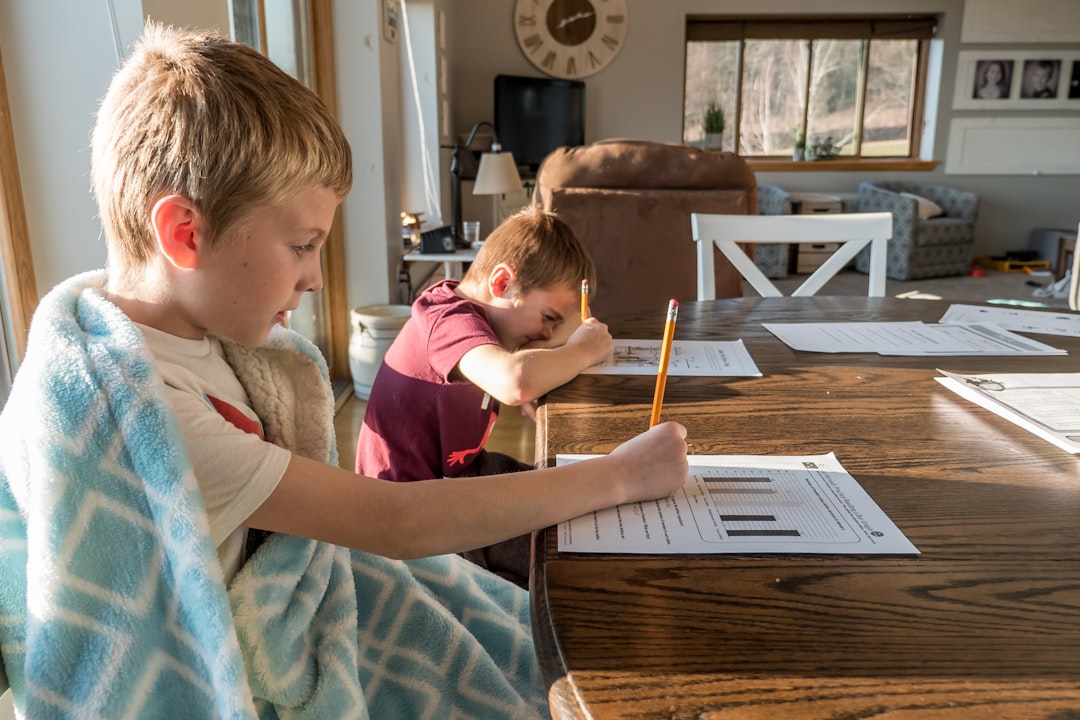
Academic success is a student's ability to achieve their educational goals while developing their well-being and lasting skills. This definition goes far beyond grades on a report card. It encompasses personal growth, self-confidence, and skills that will serve the student throughout their life. In France, 91,4% of candidates In 2024, 100,000 people obtained their baccalaureate diplomas. This figure shows that academic success is attainable, but that it requires much more than memorization.
What is academic success and why redefine it?
The most common definition of academic success is limited to numerical results. This is a framing error. A student can achieve good grades while accumulating stress, losing their curiosity, and developing a dependence on external validation. Genuine academic success combines solid foundations with sustained motivation.
Research in educational psychology distinguishes between two types of success. Apparent success relies on occasional efforts and external pressure. Lasting success is based on deep understanding, consistency, and self-confidence. Only the latter prepares students for the challenges of secondary school, CEGEP, and adult life.
Modern educational success objectives therefore include transversal skills: time management, clear communication, perseverance in the face of difficulty, and collaboration with others. These skills are not assessed on a single assignment, but they determine each student's long-term trajectory.

What are the key factors that influence academic success?
Academic success depends on 7 interdependent levers Environment, sleep, study methods, regularity, motivation, confidence, and support: this model, developed from 30 years of research in school psychology, changes the way we analyze a student's difficulties. It's not a single factor that's the obstacle; it's often the weakest link in the chain.
Here are these 7 levers in detail:
Environment A quiet, well-lit workspace free from digital distractions improves concentration. A dedicated desk, even a small one, sends a clear signal to the brain: it's time to work.
Sleep A well-rested student retains information better, manages their emotions better, and solves problems more effectively. quality of sleep directly influences the consolidation of learning.
Method Working hard is not enough if the method is ineffective. Spaced repetition, active summarization, and practice exercises are far superior to passive rereading.
Regularity 30 minutes of daily work is better than 3 hours on Sunday evening. Regularity builds automatic responses and reduces mental workload.
Motivation It stems from a sense of competence, not the other way around. When a student understands they are making progress, they want to continue. Explore the 7 levers of motivation to explore this point further.
Trust : belief in its ability to progress The belief that effort is the strongest predictor of academic success, according to a study of nearly 250 adolescents aged 15 to 19. This growth mindset, called growth mindset In English, it transforms mistakes into learning opportunities.
Support : a caring adult who asks the right questions, structures the work and encourages without pressure makes a measurable difference.
Pro tip: Identify your child's weakest link before taking action. Strengthening strengths doesn't compensate for a broken link. A bright but exhausted or anxious student won't perform at their true potential.
How can we measure academic success beyond grades?
Grades measure a specific moment, under specific conditions. They don't capture curiosity, perseverance, or the ability to learn from mistakes. A student who goes from 10/20 to 14/20 thanks to a rigorous organization This perfectly illustrates what structured support can produce. But this same student must also gain confidence and autonomy for this progress to be sustained over time.
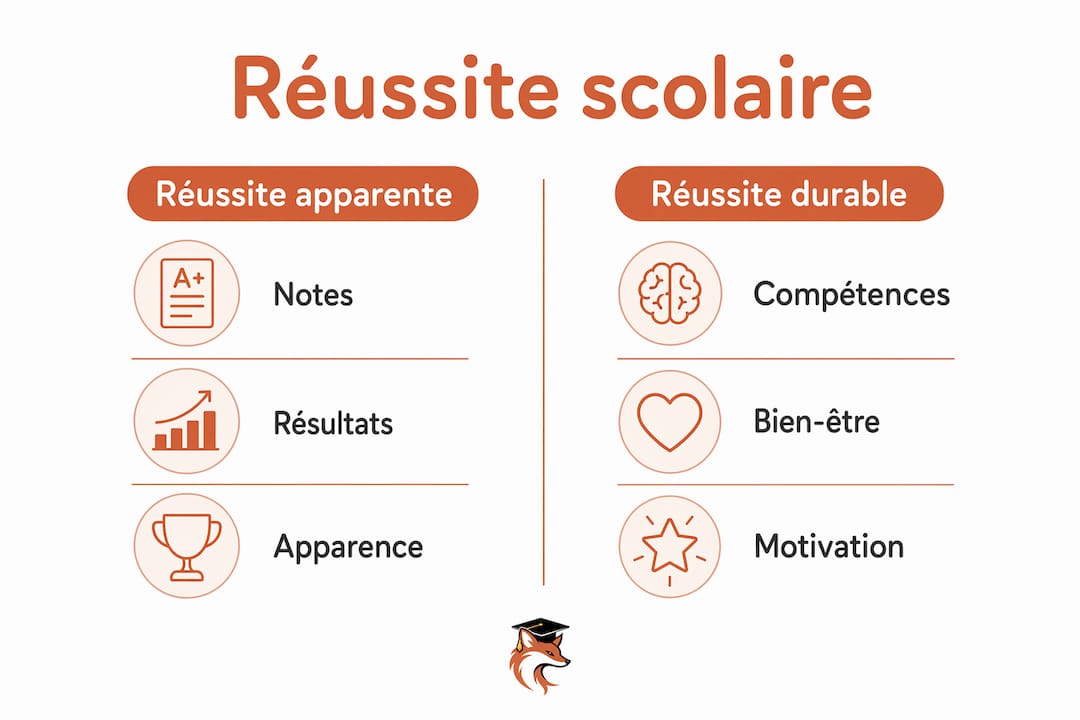
Here is a grid to assess academic success more comprehensively:
| Indicator | Apparent success | Lasting success |
|---|---|---|
| Exam results | Good results on occasion | Steady progress over the year |
| Attitude towards error | Discouragement or avoidance | Analysis and active correction |
| Motivation | External (fear of the grade) | Internal (desire to understand) |
| Management of time | Last-minute work | Regular weekly planning |
| emotional well-being | High stress, anxiety | Confidence and serenity in the face of challenges |
Ignoring emotional well-being can lead to a fragile, apparent success, even when results seem good. A student who succeeds under constant pressure risks burnout as soon as that external pressure disappears. Sustainable success, however, withstands this test.
What practical strategies can support academic success?
The most effective strategies for academic success combine organization, appropriate methods, and environmental management. Here is a concrete four-step approach:
Create a weekly schedule. Plan your study time in advance, taking extracurricular activities into account. Establishing stable routines reduces the stress associated with procrastination and frees up mental energy for concentration. A paper or digital planner is sufficient, provided you check it every morning.
Apply spaced repetition. Spaced repetition improves long-term memory far more than intensive cramming. The principle is simple: review a concept just before you forget it, then gradually space out the reviews. Tools such as revision cards or the microlearning allow this technique to be easily applied on a daily basis.
Adapt the method to the learning profile. Students who identify their learning style (Visual, auditory, or kinesthetic) learners progress more effectively. A visual learner will benefit from diagrams and mind maps. An auditory learner will retain information better by reading aloud or recording themselves.
Manage the environment and screen time. Turn off notifications during work periods. Set a clear limit for recreational screen time. A predictable and calm environment reduces cognitive load and improves attention span. For practical homework management tips, see this dedicated resource.
Pro tip: Discipline is not a constraint. It is a tool for freedom. A student who knows when and how to work no longer has to decide each evening whether to open their notebooks. The decision has already been made. That is true academic autonomy.
What are some common pitfalls to avoid?
Some mistakes hinder students' progress without parents or educators realizing it. Identifying them is the first step to correcting them.
Confusing quantity with quality. Working for four hours without a method produces fewer results than 90 minutes of structured work. Raw effort without a growth mindset is not enough.
Neglecting emotional well-being. An anxious or demotivated student cannot learn effectively, even with the best resources. Emotional support is an integral part of academic success.
Ignoring regularity. Last-minute revisions create an illusion of preparation. Long-term memory is built through repeated and spaced-out exposure, not through isolated intensive sessions.
Resisting a change of method. Many students continue to passively review their notes because it's comfortable. If a method doesn't produce results after 3 to 4 weeks, it's necessary to change it.
Underestimating the importance of support. A student who works alone without structured feedback can develop bad habits. A supportive external perspective, whether from a parent, teacher, or tutor, accelerates progress.
Key points
Sustainable academic success relies on 7 interdependent levers, and it is always the weakest link that slows down the entire system.
| Point | Details |
|---|---|
| Multidimensional definition | Academic success encompasses results, well-being, and lasting skills. |
| The 7 essential levers | Environment, sleep, method, regularity, motivation, confidence and support work together. |
| Growth mindset | Believing in one's ability to progress is the most predictive motivational factor for success. |
| Spaced Repetition | Reviewing concepts at increasing intervals surpasses cramming for long-term memorization. |
| Lasting success vs. apparent success | Success without emotional well-being is fragile and cannot withstand the pressure of time. |
What 25 years of mentoring have taught me about academic success
After years of observing students progress or stagnate, one conviction has become clear: most academic difficulties do not stem from a lack of intelligence. They stem from a broken link in a system that no one has taken the time to audit.
I've seen students work two hours a night without results, simply because their method was ineffective and they weren't getting enough sleep. I've seen others double their results in six weeks, not by working harder, but by working differently, with a clear framework and an adult who believed in them.
What still strikes me today is the resistance to change. Families often try to correct the symptom (bad grades) without addressing the cause (study methods, confidence, environment). Changing a school habit requires three to four weeks of consistent effort. It's uncomfortable at first. But the results are real and measurable.
My advice to parents: don't look for a miracle solution. Look for the weakest link. Ask your child simple questions. Does he sleep well? Does he understand what he's studying, or is he just copying? Does he believe he can improve? The answers to these three questions will already guide your actions.
Réussite A+
Personalized tutoring: concrete support for academic success
Understanding the factors that contribute to academic success is one thing. Implementing them on a daily basis is another, especially when your child is resistant or you lack the time to support them effectively.

Reussiteaplus supports over 2,500 elementary and high school students in Quebec with a customized approach tailored to each child's profile. With over 25 years of experience and a 99% satisfaction rate, Reussite A+'s university-trained tutors work precisely on the weaknesses identified for each student. Whether you prefer the tutoring at home or onlineBoth formats offer the flexibility your family needs to build lasting success. Also discover the advantages of online tutoring to understand how this format supports motivation and regularity.
F.A.Q
What exactly is academic success?
Academic success is the achievement of a student's educational goals, combined with the development of their well-being and lasting skills. It goes beyond grades to include motivation, self-confidence, and autonomy.
What are the main factors in academic success?
Academic success depends on seven interdependent factors: environment, sleep, study methods, consistency, motivation, confidence, and support. The weakest factor hinders the entire system, regardless of the strength of the others.
How can academic success be measured other than by grades?
Academic success is measured by consistent progress, attitude towards mistakes, intrinsic motivation, and emotional well-being. A student who progresses steadily and works with confidence achieves lasting success, even if their grades are not yet perfect.
Is spaced repetition really more effective than cramming?
Yes. Spaced repetition improves long-term memory much more than intensive cramming, according to cognitive science data. It involves reviewing a concept just before forgetting it, then gradually spacing out the reviews.
At what age should we start working on good school habits?
Good school habits are established from primary school onwards. The earlier they are ingrained, the more automatic they become and the more mental energy they free up for more complex learning in secondary school.