


In Laval, six private schools are most frequently mentioned in families' searches: Collège Laval and Collège Letendre (secondary), Collège Citoyen and North Star Academy Laval (often with entrance exams), as well as École Montessori de Laval and Académie Culturelle de Laval, which are more focused on preschool and elementary school with a unique pedagogy. The rest of this article details the grade levels, admission requirements, costs, and required site visits for each school.
In short:
- The majority of private schools in Laval, such as Collège Laval and Collège Letendre, recruit quickly, requiring early registration and preparation for tests.
- Admission exams typically include tests in French, mathematics, logic, and an interview that assess the student's motivation and profile.
- The annual cost varies depending on the level and options, with additional charges for transportation, extracurricular activities and sometimes the uniform.
- It is essential to visit several establishments, check class sizes, supervision, and support services to avoid making unsuitable choices.
- Targeted test preparation, with simulations and specific support, can significantly increase the chances of success.
Table of contents
- What private schools are there in Laval?
- Schools that require an entrance exam: who, what, and how
- How to compare schools based on your child's profile?
- What should be checked during a visit or admission interview?
- How much does a private school cost in Laval, and how can I reduce the bill?
- Open days and registration calendar: when is the best time to act?
- Why targeted preparation changes the result of the entrance exam
- Where can I find the exact coordinates of each school?
- Is school transportation included in private schools in Laval?
- What do parents say about private schools in Laval?
- What extracurricular services do private schools in Laval offer?
- My recommendation for choosing a private school in Laval
- Réussite A+ helps you prepare for admission to these schools
- Sources
- F.A.Q
What private schools are there in Laval?
Before rushing to a visit or entrance exam, it's best to know exactly what each institution offers. Here are some concise fact sheets to help you quickly get your bearings, outlining the levels offered, the language of instruction, and each school's unique teaching methods. This information changes from year to year, so always check the details on the school's official website before committing.
Laval College
Collège Laval welcomes secondary school students with an educational program that emphasizes sports, arts, and technology. The school outlines its development priorities directly on its website. official admissions pageThis is a necessary step if you are considering enrolling your child. Instruction is in French, and the school is consistently ranked among the top schools in the region for its academic results.
College Letendre
Another pillar of private secondary education in Laval, Collège Letendre, appears just as frequently in local comparisons alongside Collège Laval. Its program covers the entire secondary level in French, with a reputation built on academic rigor. As with any popular school, places fill up quickly: it's best to register early rather than waiting until the last minute.
Citizen College
The Citizen College distinguishes itself through an approach that emphasizes civic and community engagement among students, in addition to the regular academic program. The school welcomes high school students and, like many of its counterparts, uses an admissions process with assessments. Consult its admissions page for the exact schedule of tests and open houses for the current academic year.
North Star Academy Laval
North Star Academy Laval offers a learning environment that emphasizes the development of leadership and 21st-century skills. The institution is among the schools identifiable through the FEEP criteria-based search enginewhich confirms its official name and exact location.
Montessori School of Laval
Here, the teaching approach takes a completely different turn. The Montessori School of Laval applies the Montessori method, renowned for its individualized approach where children progress at their own pace in a structured yet flexible environment. It primarily serves preschool and elementary school children, making it a relevant choice for parents seeking an alternative to the traditional model from the earliest years.
Laval Cultural Academy
The Laval Cultural Academy emphasizes cultural openness and sometimes offers bilingual or multilingual instruction, depending on the program. It primarily targets preschool and elementary school students. As with other specialized schools, request a detailed description of the curriculum before registering, as the term "cultural" can encompass different realities from one institution to another.
These six schools represent only a portion of the actual offerings. The Quebec Federation of Private Educational Institutions (Fédération des établissements d'enseignement privés du Québec) includes over 200 member schools across the province, and its map-based search tool remains the most reliable way to locate active private schools in Laval, including those not listed in standard rankings. Always check:
- if the school is a member of the FEEP (a mark of recognition, not a guarantee of quality in itself)
- the exact level offered (some schools stop at primary school, others only accept students from secondary school onwards)
- the main language of instruction and the second language options
- the existence of a religious component, which sometimes influences the schedule and certain educational content
Schools that require an entrance exam: who, what, and how
Several recognized schools in Laval, including Collège Laval, Collège Letendre, Collège Citoyen, and North Star Academy, use an admissions process with assessment. However, policies vary from year to year and from one institution to another: the only way to know the exact procedures is to consult each school's admissions page, as recommended by the FEEP in its admissions resources.
Typical tests generally fall into the following categories:
- French : reading comprehension, spelling and sometimes short writing, to assess the level of language proficiency.
- Mathematics : problem-solving adapted to the targeted school level, often timed.
- Logic or reasoning : exercises that measure analytical skills rather than acquired knowledge.
- Interviews : meeting with the student, sometimes with the parents, to assess motivation and suitability with the school's educational project.
The report cards from the last two years are also part of the application in several schools. Some schools even make their final decision contingent on receiving the end-of-year report cards, as specified by the... Admission procedure for Collège Saint-Sacrement, a fairly widespread practice in the Quebec private network.
Pro tip: Prepare a single PDF document containing transcripts, identification, and forms rather than several separate files. Admissions offices process applications more quickly when everything is in one place, and you avoid the back-and-forth emails that waste valuable time before the deadline.
To avoid the most common submission errors: respect the test registration deadline (often several weeks before the test itself), check that the form is signed by the correct parent or legal guardian, and confirm receipt of your application by email or phone if the school does not do so automatically.
How to compare schools based on your child's profile?
A numerical ranking never tells the whole story. Local rankings, like those compiled by Laval with the FamilyThese assessments often measure exam results, not the support provided or the suitability of the program for your child's temperament. A high grade guarantees nothing if the student feels lost in a large group or in a teaching method that is too rigid for them.
Here are the key factors that really matter in a useful comparison:
- Language of instruction and programs offered in a second language
- Academic level and requirements (workload, pace of assessments)
- Educational project (sports, arts, religious, Montessori, civic)
- Group size and student/teacher ratio
- Supervision and support (on-site homework help, personalized support, services for students with special needs)
- extracurricular options available according to the child's interests
- Actual total cost, beyond the displayed tuition fees
Three profiles, for example: a child who needs to move and channel their energy will often find their place in a sports-oriented school like Collège Laval. A more independent and curious child will sometimes thrive better in a Montessori environment, where they progress at their own pace. And a student who needs close academic supervision, with clear expectations and a fast pace, will sometimes feel more comfortable in a traditional school like Collège Letendre.
These correspondences remain avenues for reflection, not absolute truths. Nothing replaces a visit to the school to experience its true atmosphere.
What should be checked during a visit or admission interview?
Once you have established your shortlist, the visit becomes the decisive step. Prioritize these criteria in the following order: the educational adaptation to your child's profile, the imposed pace of work, the support services actually available (not just advertised), the distance and daily commute, and then the total cost.
Once there, ask these twelve specific questions:
- How many students are in a typical class at this level?
- How does the school manage students who need a different pace?
- What academic support services are available outside of school hours?
- Is there a before and after school care service?
- How does the transition between primary and secondary school take place in the institution, if it covers both?
- What has been the pass rate for ministerial exams in recent years?
- How many extracurricular options are actually offered each session?
- How does the school communicate with parents about the child's progress?
- What are the exact procedures in case of failure in a subject?
- Is the teaching staff stable from year to year?
- What scholarships or financial aid are available, and according to what criteria?
- What happens if places become available after the start of the school year?
Pro tip: Write down the answers right after each visit, while they're still fresh in your mind. After three or four schools, the details easily become muddled, and it's precisely this dispassionate comparison that reveals the real differences.
A warning sign to watch out for: a school that avoids providing specific information about the student-teacher ratio or the success rate. An institution confident in its results shares this information openly.
How much does a private school cost in Laval, and how can I reduce the bill?
Tuition fees vary enormously according to The level and services included are key factors. Preschool and primary school generally have lower fees than secondary school, where specialized programs (sports, arts, technology) significantly increase costs. Schools with boarding facilities or international programs are obviously in the higher price bracket.
Many private schools offer scholarships or financial aid, a point that the FEEP encourages families to explore directly with each institution, as the criteria and amounts vary from one school to another. Never assume a school is out of reach without asking.
To calculate the actual cost of a school year, add:
- annual tuition fees
- registration or confirmation fees, often non-refundable
- uniforms and specific school supplies
- Transportation, if the school does not offer bus service
- extracurricular activities are charged separately from the basic package
Accepting an offer of admission usually involves signing a service agreement, which outlines the fees, payment terms, and rules of the institution. Read this agreement before signing, not after.
Open days and registration calendar: when is the best time to act?
The calendar for private schools generally follows a predictable rhythm: open days are held in the fall or winter, entrance exams often take place between November and January, and registration for the following year is confirmed in the spring. Places may sometimes become available later if families withdraw, but it's best not to count on this scenario.
To organize your tasks without getting scattered:
- Check each school's admissions page the previous summer to note open house dates.
- Book your visit or test slot as soon as registration opens, as some schools operate on a first-come, first-served basis.
- Prepare the required documents in advance: recent report cards, child's identity document, completed registration form.
- Plan two to four visits over a period of a few weeks, to compare schools with fresh impressions.
- Confirm in writing each step taken (application submitted, test completed, interview held) to keep a record in case of administrative questions.
Why targeted preparation changes the result of the entrance exam
A child who has already seen the format of a test, who has practiced the type of exercises asked and who has done at least one mock interview arrives at the test with a completely different level of confidence than a child who is discovering everything on the day.
Réussite A+ has built its method around this simple principle: targeted preparation makes a measurable difference. The company states that its customer satisfaction rate reflects the consistent support offered by university tutors selected for their mastery of French and mathematics, the two subjects most often tested during the admissions process.
In concrete terms, effective preparation combines test simulations in conditions close to reality, a work plan targeted at specific gaps in French and mathematics, and interview training so that the child learns to express their motivation in their own words.

Pro tip: Begin preparation at least six to eight weeks before the test date, with one to two sessions per week. A child who leaves it to the last minute rarely catches up on the gaps in knowledge accumulated over several months.
Where can I find the exact coordinates of each school?
Addresses, phone numbers, and websites sometimes change, making it risky to copy them from one article to another without verification. The most reliable method remains using the FEEP map search tool, which geolocates member schools in Laval and displays their up-to-date contact information directly on each school's profile.
For Collège Laval, the official admissions page lists the full address, the secretariat's phone number, and links to the registration forms. The same applies to Collège Letendre, Collège Citoyen, and North Star Academy Laval: each official website displays its contact information in the footer or in a dedicated "contact" section.
A simple tip before calling or visiting: note down the exact name of the person in charge of admissions if the website specifies it. This avoids wasting time being transferred from one department to another on your first call, especially during peak periods like autumn, when the reception desks receive the most calls from families.
Always confirm the exact address corresponding to the level you are interested in before going there.
Is school transportation included in private schools in Laval?
Unlike the public transport system, school transport is not automatically free or guaranteed in private schools. Some schools organize their own bus service by geographic area, for an additional annual fee. Others do not provide this service at all, and families must then make alternative arrangements: carpooling, public transport, or driving.
A school located near a major road or metro station (like those near the Sainte-Dorothée area or downtown Laval) makes travel easier for families without school bus service. Conversely, a school further from the city centre can represent a significant daily commute if you live on the other side of town.
Before committing, ask the school directly:
- if a transportation service is offered, and for which specific areas of Laval
- the annual cost of this service, separate from tuition fees
- the actual pick-up and return times, which influence the family routine
- the existence of partial transport options (for example, only in the morning or only on certain days)
For families considering a school further from their home, it is better to test the actual journey during peak hours before signing a contract, rather than relying solely on the distance shown on a map.
What do parents say about private schools in Laval?
Parents' opinions remain a valuable source, but should be read with discernment. An enthusiastic or negative comment often reflects a very personal experience: the temperament of a particular child, a specific school year, sometimes even a single teacher.
Local platforms like Laval en Famille compile useful indicators to identify general trends, but this data primarily measures numerical academic results, not the daily human experience of a student. A high score on this type of platform does not guarantee that the classroom atmosphere is suitable for a more sensitive or introverted child.
The best way to gather reliable opinions is often through direct word of mouth from other parents in your neighborhood, or online parent groups specific to Laval. Ask specific questions rather than general ones: ask how the school handled a concrete situation (a child in difficulty, a conflict between students, communication with parents) rather than simply stating "it's a good school" which says nothing about how it actually operates.
Always cross-check several sources of opinion before relying on a single opinion, however convincing it may be.
What extracurricular services do private schools in Laval offer?
Beyond the academic program, extracurricular services often play a significant role in a family's final choice.
On-site academic support deserves special attention when asking questions during your visit. Some schools offer supervised homework help directly after classes, while others limit it to the classroom and leave parents entirely responsible for follow-up at home. This difference can be significant if your child needs extra support, particularly in French or mathematics, the two subjects where the need for support remains most frequent in both elementary and secondary school.
Also ask if the school offers a paid in-house tutoring service, or if it recommends that families seek external support outside of its walls.
My recommendation for choosing a private school in Laval
After reviewing the procedures, costs, and profiles of schools, one conviction emerges: visit several schools before making a decision, even if the first one seems perfect on paper. A brochure never truly captures the atmosphere of a classroom on a typical Tuesday.
If an entrance exam is part of the process, don't leave your preparation until the last minute. Schools that test in French and mathematics assess skills that are built up over several weeks, not in a single weekend of intensive revision.
Use the available resources to compare objectively, and don't hesitate to ask a school advisor for advice if the choice seems complex. entrance exam preparation guide can clarify what distinguishes a simple review from true strategic preparation.
— Jad
Réussite A+ helps you prepare for admission to these schools
Choosing the right school isn't enough if your child isn't ready on test day. Réussite A+ focuses precisely where Laval's private schools place the most emphasis: French and mathematics, with university-level tutors who understand the actual format of these entrance exams.
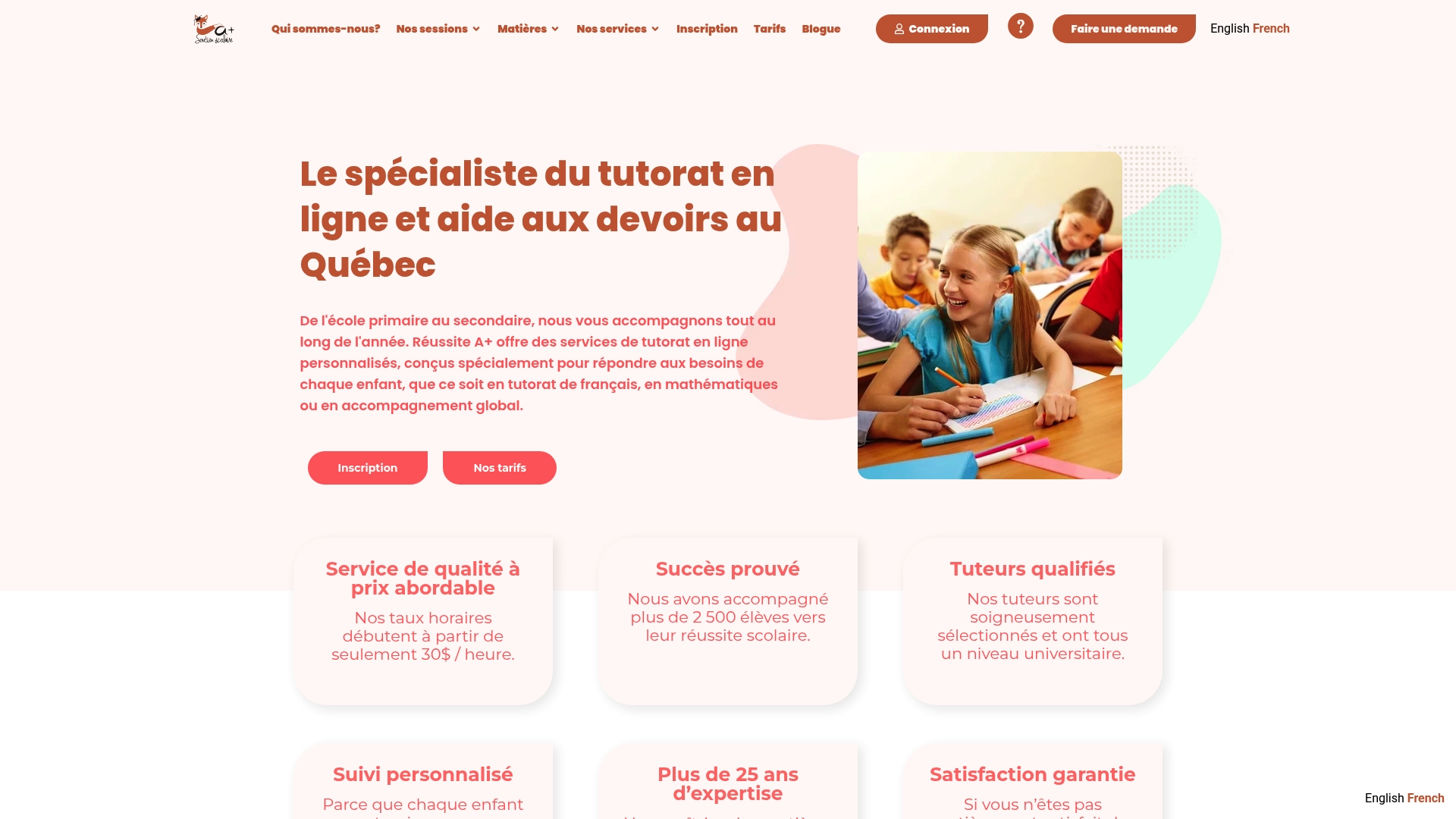
The service offers a diagnostic assessment to precisely identify your child's learning gaps, followed by individual sessions with no mandatory subscription. The online format also simplifies logistics when multiple school visits are scheduled in the same month.
To obtain a personalized plan tailored to the admissions calendar of your target school, please consult the page Registration for tutoring and academic support and specify the targeted school: a tutor will be able to guide the preparation according to the type of tests actually posed by that establishment.
Sources
Always check dates and prices on each school's official website before committing. The FEEP remains the reference for confirming a school's membership in Quebec's recognized private network.
- Schools in Laval 2026: Elementary, Secondary and Private Schools — Laval for Families
- Admissions | Laval College
F.A.Q
What is the best private school in Laval?
There is no single best school: Collège Laval and Collège Letendre often appear in comparisons for their academic results, but the choice depends mainly on the educational project, the pace and the support services that suit your child.
What are the best private schools to consider in Laval?
Collège Laval, Collège Letendre, Collège Citoyen and North Star Academy Laval are among the most cited secondary schools, while École Montessori de Laval and Académie Culturelle de Laval stand out in preschool and elementary school for their particular pedagogy.
How to prepare for a private school entrance exam?
Targeted preparation in French and mathematics, combined with test simulations and interview training, increases the chances of success; support like that of Réussite A+ allows this work to be structured over several weeks before the test date.